Pet Obesity
Learn how to recognize if your pet is overweight, understand how excess weight can affect their health, and discover simple steps you can take to help your pet reach and maintain a healthy weight.
Dr. Sofia Raldiris
DVM
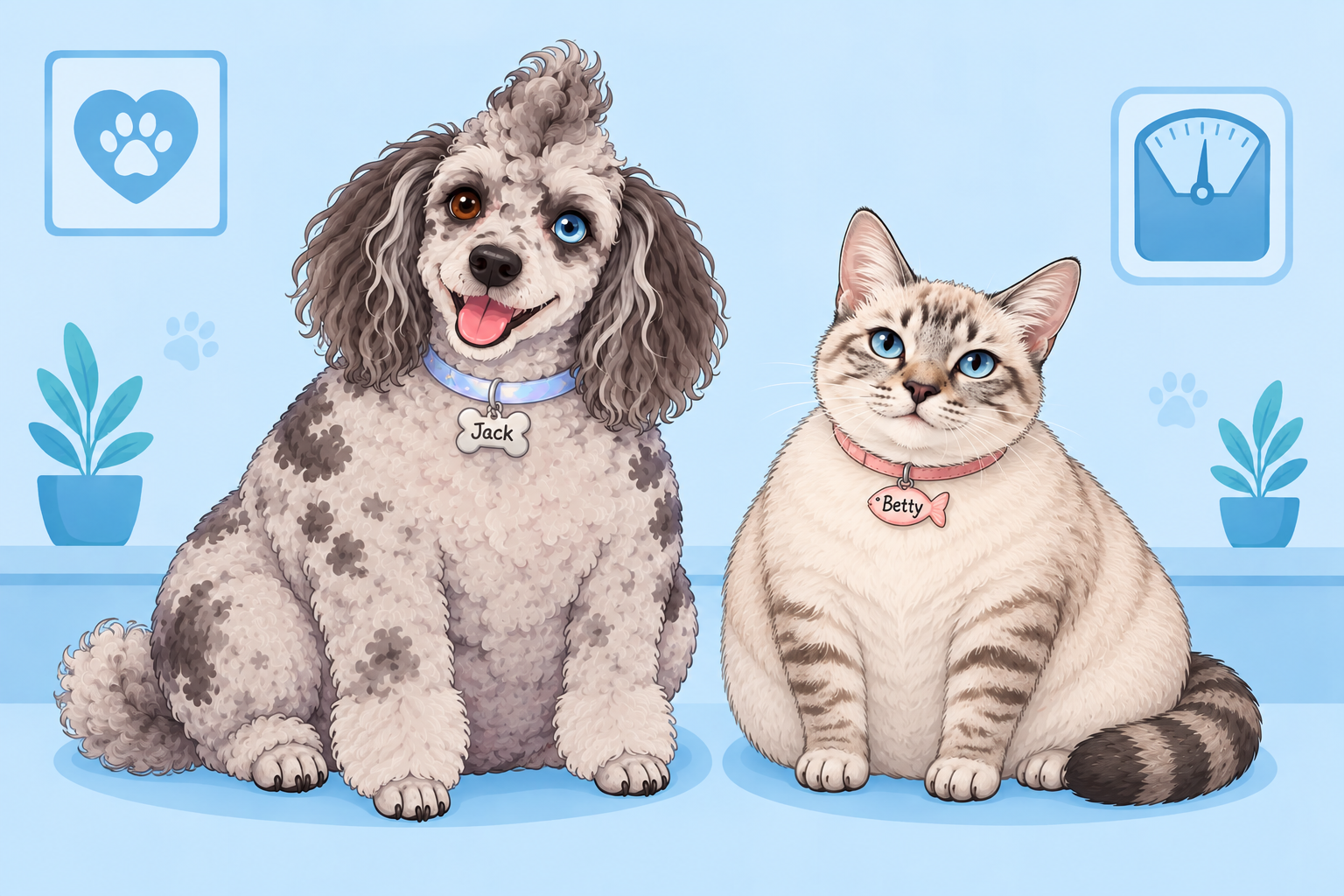
⚖️ PET OBESITY
Helping Your Pet Reach a Healthy Weight
Obesity has become an extremely important health problem in our pets.
Many pet owners don't realize their pet is overweight. Because overweight pets have become so common, carrying extra weight can start to look “normal.”
But there is nothing normal or healthy about being overweight.
Your pet depends completely on you for their food, treats, and activity. You have a lot of control over your pet's weight—and small changes can make a big difference.
❤️ WHY DOES A HEALTHY WEIGHT MATTER?
Being overweight is more than a cosmetic issue.
Extra weight is associated with an increased risk of:
- 🦴 Joint disease and arthritis
- 🩸 Diabetes
- 🫁 Breathing and respiratory problems
- ❤️ Cardiovascular disease
- 🫘 Kidney disease
- 🩺 Pancreatic disease
- 🚽 Bladder and urinary problems
- 🐾 Skin problems
- 🎗️ Certain types of cancer
- 💉 Increased surgical and anesthetic risk
- ⏳ Decreased quality and length of life
❤️ A healthy weight means more than looking better.
Keeping your pet at a healthy weight can help them move more comfortably, stay healthier, and enjoy a better quality of life.
🐾 HOW DO I KNOW IF MY PET IS OVERWEIGHT?
Sometimes it is difficult to recognize—or accept—that our pet is overweight.
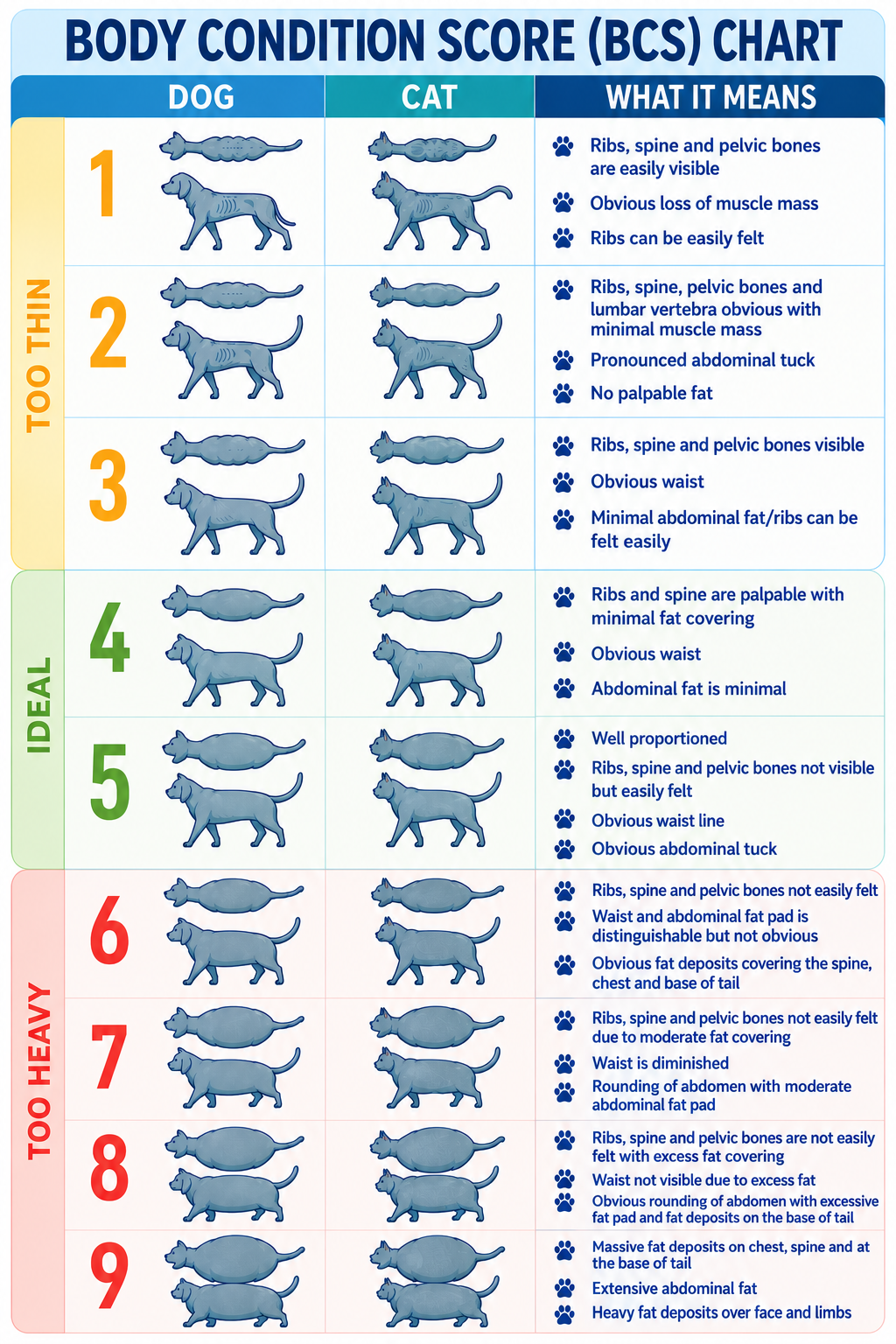
We use a 9-point Body Condition Score (BCS) to evaluate body fat.
⭐ IDEAL = 5/9
At an ideal body condition:
- You should be able to easily feel your pet's ribs without a thick layer of fat covering them.
- Your pet should have a visible waist when viewed from above.
- There should be a slight abdominal tuck when viewed from the side.
If you're not sure whether your pet is overweight, ask us to check their BCS.
🥣 HOW MUCH SHOULD I FEED?
The feeding guide on the bag is a starting point—not a prescription.
Just because the food bag recommends a certain amount doesn't mean that amount is right for your pet.
We generally want to feed for their ideal weight—not their current weight.
Every pet is different. Ideally, you should know how many calories your pet is eating compared with how many calories they are using.
Calories in vs. calories out = weight gained, lost, or maintained.
🐾 A simple rule:
- 📈 Gaining weight? Feed a little less.
- 📉 Losing too much weight? Feed a little more.
- ⚖️ Weight not changing as expected? Contact your veterinarian.
Your veterinarian can help determine the right calorie intake and adjust the plan based on your pet's progress.
⚠️ Don't drastically cut a regular maintenance food on your own.
Feeding too little of a regular diet can result in inadequate intake of essential nutrients. A veterinary weight-loss diet may be a better option because it provides complete nutrition while controlling calories.
🧮 HOW DO WE CALCULATE CALORIES?
Instead of trying to do the math yourself—use the Pet Nutrition Alliance Calorie Calculator to estimate your pet's daily calorie and feeding needs.
🌐 Pet Nutrition Alliance Calorie Calculator
Use the results as a guideline and always confirm the feeding plan with your veterinarian.
For dogs, we can estimate their resting energy requirement (RER):
- RER = 70 × (ideal weight in kg)^0.75
- To convert pounds to kilograms: kg = pounds ÷ 2.2
- Example:
- Ideal weight = 40 lb
- 40 ÷ 2.2 = 18.2 kg
- 70 × (18.2)^0.75 ≈ 600 kcal/day
- If the food contains 350 kcal/cup:
- 600 kcal ÷ 350 kcal/cup ≈ 1.7 cups/day
- If the food contains 350 kcal/cup:
🩺 This is only a starting point.
Your veterinarian may adjust the amount based on your pet's individual needs, activity level, body condition, and the diet being used.
🥤 A “CUP” IS NOT ALWAYS A CUP!
How you measure food matters.
A cup of food should mean an actual measuring cup—not a coffee mug, drinking cup, or whatever container happens to be in the kitchen.
Different containers can hold very different amounts.
⭐ For even greater accuracy:
Use a gram/kitchen scale to weigh your pet's food.
Measure the food. Don't eyeball it.
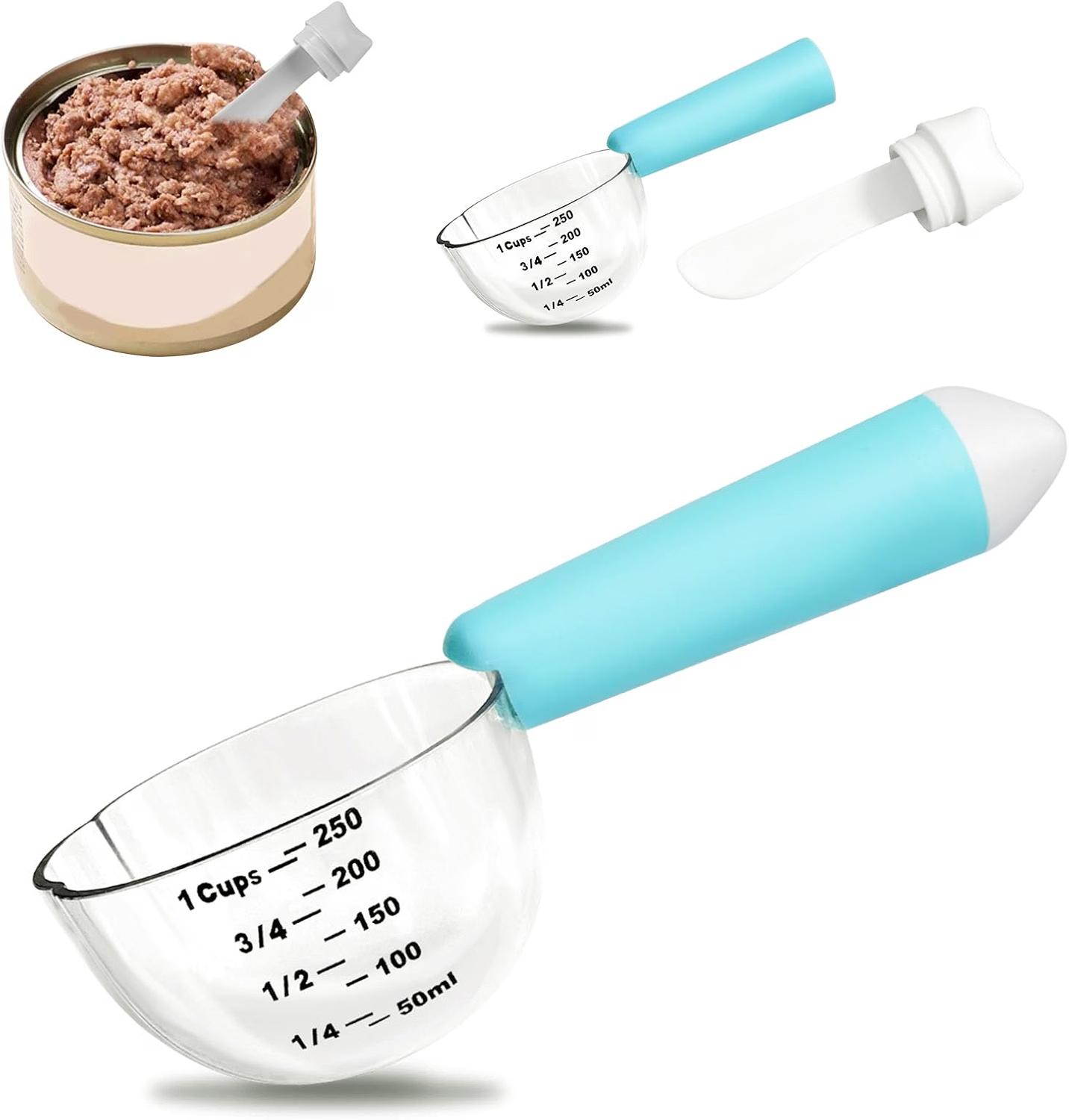
Dog & Cat Food Measuring Scoop
A 1-cup measuring scoop designed to help you measure consistent portions of dry or wet food for your dog or cat. Features easy-to-read measurement markings and a long handle for convenient feeding.
Amazon affiliate link
🥫 PRESCRIPTION WEIGHT-LOSS DIETS
For pets that need to lose weight, a veterinary weight-loss diet can make calorie restriction easier while providing complete, balanced nutrition.
Some commonly used options include:
- Royal Canin Satiety
- Hill’s Prescription Diet Metabolic or r/d
- Purina Pro Plan Veterinary Diets OM
Your veterinarian can help determine which diet is most appropriate for your pet based on their weight, health, nutritional needs, and weight-loss goals.
🛒 Looking for nutrition or “treat” products to support your pet's healthy weight? Explore some of our recommended options below.
🍖 DON'T FORGET THE TREATS!
Treats count—but you don't have to stop giving them!
Treats are part of your pet's daily calorie intake. It’s not necessarily about which treats you give—it’s about how much and how often.
⭐ Treats should make up no more than about 10% of your pet's daily calories.
Treats, table food, chews, food toppers, supplements, and even food used to give medications can all add calories.
❤️ Easy Tip: Save a small portion of your pet's daily food allowance to use as treats throughout the day.
Lower-calorie options include:
- 🫛 Green beans
- 🥕 Small pieces of carrot
- 🌿 Small pieces of celery
- 🩺 Veterinary-approved low-calorie treats
⭐ Our Recommendations:
- Treats for Weight Management Metabolic – Hill’s
- Treats Weight Management – Royal Canin Satiety
🛒 Looking for nutrition or treat products to support your pet’s healthy weight? Explore some of our recommended options below.
👨👩👧👦 EVERYONE IN THE HOUSE HAS TO HELP!
Weight loss is much harder when one person is following the plan and someone else is giving extra food.
⭐ Everyone must follow the same meal plan.
Extra calories can come from:
- 🍖 Treats
- 🍽️ Table food
- 🥨 Food dropped on the floor
- 👧 Children sharing snacks
- 🗑️ Unsecured trash
- 🐶 Another pet's food bowl
- 🍴 Food left within reach
👨👩👧👦 Have children at home?
One of the easiest solutions is to keep pets safely separated while people are eating and keep food out of their reach by using things such as a baby gate.
🐾 Have Multiple Pets at Home?
Feed each pet separately in a designated, enclosed space, such as a bathroom, bedroom, or feeding crate.
🥣 Place each pet's measured food portion in their designated space for 30 minutes, twice a day.
⏰ After 30 minutes, pick up any uneaten food until the next scheduled meal.
Timed feeders can also be helpful for pets that need scheduled meals or for households where feeding at specific times is difficult.
This helps prevent pets from eating each other's food and makes it easier to know exactly how much each pet is eating.
One extra meal here. A few treats there. A bite from the table. It all adds up.
🛒 Looking for nutrition or treat products to support your pet's healthy weight? Explore some of our recommended options below.
✂️ SPAY & NEUTER CAN AFFECT WEIGHT
Spaying and neutering are important for your pet's health and help prevent unwanted litters.
However, after sterilization, some pets have lower energy requirements and may need fewer calories to maintain a healthy weight.
🩺 Reassess your pet's food intake after surgery.
Their calorie needs can change throughout life, so their feeding amount should be reassessed regularly.
🐾 EXERCISE MATTERS TOO!
Weight management isn't only about food.
Depending on your pet's health, age, weight, and physical abilities, we may recommend:
- 🚶 Daily walks
- 🧸 Interactive toys
- 🧩 Food puzzles
- 🎾 Short play sessions
- 🐾 More opportunities to move around
- 🐱 Climbing structures and interactive toys for cats
⚠️ Exercise should be appropriate for your pet.
An overweight pet with arthritis, heart disease, respiratory disease, or another medical condition may not be able to exercise like a healthy pet.
In Puerto Rico, services such as Pawletics provide additional opportunities for safe, structured exercise.
🌐 Pawletics
🛒 Looking for toys, enrichment, or other products to help your pet stay active? Explore our recommended options below.
We'll help you find activities that are safe for your pet.
📉 HOW DO WE KNOW IF IT'S WORKING?
Weight loss should be gradual.
We recommend keeping track of your pet's weight and checking it regularly—typically every 2–4 weeks while actively trying to lose weight.
⚖️ Make weighing easy at home.
A pet or baby scale can make it easier to monitor your pet's weight regularly and track their progress between veterinary visits.
✅ If your pet is losing weight: Continue the current plan.
➡️ If your pet is not losing weight, we may need to:
- Reduce the amount of food
- Adjust the diet
- Reduce treats
- Increase appropriate activity
🩺 If your pet still isn't losing weight:
We may recommend bloodwork or additional testing to look for medical problems that could make weight loss more difficult.
We may also recommend a prescription weight-loss diet that provides complete nutrition with fewer calories and may help your pet feel more satisfied.
Some options include:
- Royal Canin Satiety Support / Weight Management for dogs & cats
- Hill’s Prescription Diet r/d OR Metabolic Diet for dogs & cats
🛒 Looking for nutrition, treats, or products to support your pet's healthy weight? Explore some of our recommended options below.
🐶 SPECIAL NOTE FOR DOGS
For dogs, a typical weight-loss goal is around 1–2% of body weight per week.
For example, a 50-lb dog may lose approximately 0.5–1 lb per week.
📉 Weight loss is a process.
As your pet loses weight, their calorie needs may change.
That's why we don't simply calculate one feeding amount and forget about it.
We monitor the weight and adjust the plan as needed.
🐱 SPECIAL NOTE FOR CATS
⚠️ Cats should NEVER be placed on a crash diet.
Rapid or excessive calorie restriction can be dangerous for cats.
Weight loss should be slow, gradual, and monitored by your veterinarian.
For some overweight cats, we may recommend:
- 🥫 A therapeutic weight-loss diet
- 💧 Higher-moisture food
- 🍽️ Measured meals instead of free-feeding
- 🧩 Food puzzles and enrichment
- 🐾 More opportunities for activity
🥫 A prescription weight-loss diet is preferred.
These diets provide complete nutrition with fewer calories.
If this isn't possible:
As a temporary starting point, your veterinarian may recommend 1/4 cup twice daily of your cat's current food, along with appropriate exercise.
⚠️ This is not recommended long-term.
Regular diets may not provide enough nutrients when portions are significantly reduced.
A veterinary weight-loss diet is preferred whenever possible.
❤️ The goal is healthy weight loss—not simply feeding less.
We want your cat to lose excess fat while maintaining proper nutrition and muscle.
❤️ THE BOTTOM LINE
Your pet cannot control what they eat—You control it!
You control:
- 🥣 How much they eat
- 🍖 How many treats they receive
- 🏠 What food is available to them
- 🐾 How much activity they get
❤️ You don't have to stop loving your pet with food.
There are plenty of ways to show your pet love without adding unnecessary calories.
⭐ Start with these simple steps:
- Measure the food.
- Limit the extras.
- Increase appropriate activity.
- Monitor the weight.
🐾 Small changes today can mean a healthier, more comfortable life for your pet tomorrow.
🛒 RECOMMENDED NUTRITION & TREAT PRODUCTS
Choosing the right food and treats can make a big difference when managing your pet’s weight. We’ve selected nutrition products and lower-calorie treat options that may be helpful additions to a healthy weight-management routine.
🌐 View Our Recommended Nutrition & Treat Products
🌐 View Our Recommended Enrichment & Exercise Products
Remember: Products and treats should be used as part of an overall weight-management plan. Your veterinarian can help determine the appropriate diet, portions, and daily calorie intake for your pet.
❓HAVE MORE QUESTIONS?
We’re here to help you keep your furbaby happy, healthy, and thriving! ❤️
For additional pet health information, visit Veterinary Partner by VIN—a trusted resource with veterinarian-written articles.
🔎 Tip: Search “VIN + your question” on Google for easier results, as the website’s search feature can be a little tricky.
📞 And remember, calling us is always free!
If you have questions or concerns about your pet, please don’t hesitate to reach out. We’re happy to help. 🐾