Recovery After MPL Surgery
Learn how to care for your dog after MPL surgery, including incision care, activity restrictions, pain management, and rehabilitation to support a safe recovery.
Dr. Sofia Raldiris
DVM
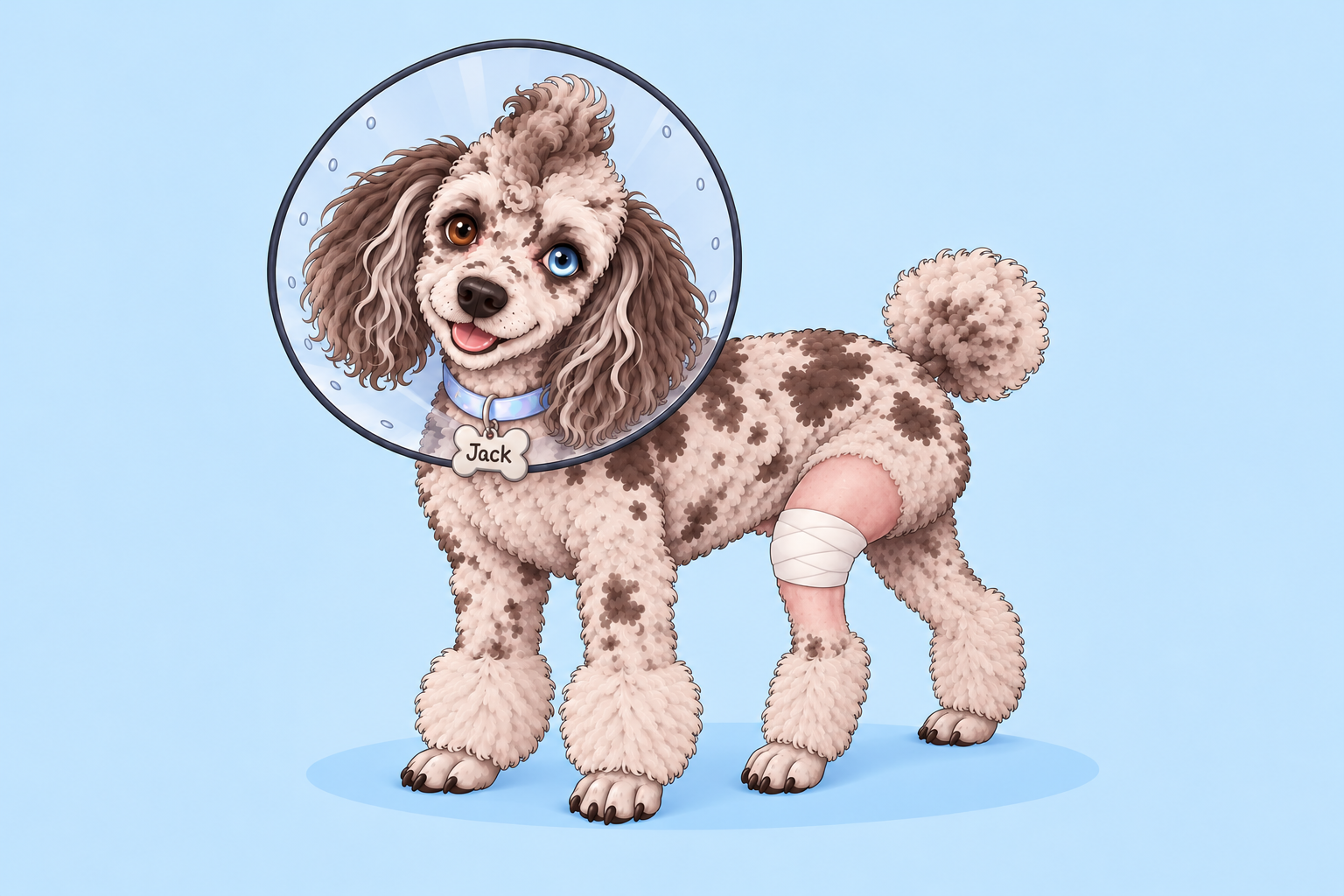
RECOVERY AFTER MPL SURGERY
Recovery after medial patellar luxation (MPL) surgery requires six to eight weeks of restricted activity to allow proper healing.
If your dog becomes anxious or difficult to confine, contact your veterinarian. Medication may be needed to help keep your dog calm and safe during recovery.
Even if your dog begins using the operated leg shortly after surgery, the bone needs time to heal before normal activity can safely resume.
After surgery, your pet may feel sore, tired, or drowsy for several hours or days. Drowsiness from anesthesia should improve within 12–24 hours.
Keep your pet indoors, warm, and comfortable during the first night. Follow the instructions below to help your pet recover safely.
🏡 HOME CARE INSTRUCTIONS
🚶 Activity Restriction
Restrict activity until bone healing is confirmed on X-rays. The first 24 hours are often the most uncomfortable.
Confine your dog to a crate or small room when not directly supervised. When outside, keep your dog on a leash and under direct supervision.
In many cases, sedation may be required to keep your pet calm and compliant in their kennel. Please discuss this with your primary care veterinarian if you feel your pet is becoming anxious or stressed.
Weeks 1–2
- No running, jumping, playing with other pets, or off-leash activity.
- Prevent access to stairs, furniture, and slippery floors.
- Take your dog outside on a leash for bathroom breaks 2–4 times daily.
- Short, slow leash walks may be recommended for 5–10 minutes, ensuring you walk slowly enough that your dog uses the operated leg with each step.
Weeks 3–8
- Continue confinement when your dog is not directly supervised.
- If the incision has healed and your veterinarian approves, gradually increase leash walks, potentially to 20–30 minutes, 2–3 times daily.
- Continue to prevent running, jumping, rough play, and uncontrolled activity.
- Keep all outdoor activity on a leash.
Weeks 9–12
- Increase activity only if the 8-week recheck and X-rays confirm adequate bone healing.
- Keeping them in a kennel is no longer needed.
- Gradually return to normal activity over 3–4 weeks. Begin with a few minutes of unrestricted activity and add a few minutes daily as tolerated.
- Leash walks can continue without a specific duration limit, as directed by your surgeon.
Your surgeon may recommend a different schedule depending on your dog's progress and follow-up imaging.
⚠️ Excessive activity can damage the incision, cause complications, and potentially require additional surgery and veterinary costs.
🩹 Incision Care
- Keep the incision clean and dry. Do not bathe your pet for 14 days after surgery.
- Do not apply ointments, creams, or other products unless directed by your veterinarian.
- Mild bruising may occur after surgery.
- Check the incision daily for redness, swelling, discharge, opening, or excessive licking.
- Cold compress: If recommended, apply a cold pack wrapped in a thin towel for 10–15 minutes, 3–4 times daily, during the first 3 days. Always place a protective layer, such as a thin towel, between the ice pack and your pet's skin.
- Warm compress: After the first 3 days, your veterinarian may recommend a warm compress for 3–5 days if the area remains bruised, painful, or swollen. Always use a protective layer and ensure the compress is not too hot.
Contact your veterinarian promptly if you notice any concerning changes to the incision.
🛡️ E-Collar: Why It’s Essential!
Sutures and surgical glue are not foolproof.
Licking, chewing, or scratching can damage the incision, introduce bacteria, reopen the wound, and lead to complications requiring additional treatment or surgery.
⚠️ Even brief licking can cause complications and increase veterinary costs. We ALWAYS recommend an e-collar (cone) after surgery.
- Keep it on AT ALL TIMES for 10–14 days, or as directed by your veterinarian.
- Your pet may feel uncomfortable or panic at first, but most pets adjust to the e-collar within a few hours.
- You may remove it briefly for meals and drinking if you supervise your pet closely and ensure they cannot reach the incision. Replace it immediately afterward.
- Never leave your pet unattended without the e-collar.
📏 HOW TO MEASURE AN E-COLLAR
The cone must extend beyond your pet’s nose to prevent access to the incision.
- Length: With the cone positioned at the base of the neck and pushed all the way back, your pet’s nose should not extend beyond the cone’s outer edge.
- Fit: It should be secure enough that your pet cannot slip out, with room for approximately two fingers between the collar and neck.
- Test: Watch your pet move to ensure they cannot reach the incision.
⚠️ If your pet’s nose extends beyond the cone’s edge, you need a longer size.
🐾 E-COLLAR OPTIONS
- Traditional plastic cone: Preferred because it provides reliable protection when properly fitted.
- Soft cone: Flexible, but some pets can bend it or reach around it to lick the incision.
- Inflatable collar: May be more comfortable but may not prevent your pet from reaching the surgical site.
- Recovery suit: May be suitable for certain incisions but does not replace an e-collar in every situation.
🛒 Preparing for your pet’s recovery? Explore some of our recommended surgery care products below.
🦴 Rehabilitation
Physical rehabilitation can help restore joint mobility, maintain muscle strength, and improve the use of the operated leg. Begin exercises only as directed by your surgeon.
If your surgeon approves passive range-of-motion exercises:
- Positioning: Lay your dog down with the operated leg facing upward and gently support the limb.
- Toe flexion and extension: Slowly flex the toes until you feel minimal resistance. Hold for 1–2 seconds, then extend the toes and hold for another 1–2 seconds. Repeat the toe movements 10–15 times.
- Joint movement: Gently flex and extend the ankle, knee, and hip, repeating each movement 10–15 times.
- Bicycle motion: If recommended, gently move the leg forward and backward in a bicycle motion for 1 minute.
- Leash walks: Follow with a slow, controlled leash walk for 5–10 minutes if recommended.
Your dog may experience mild soreness after exercises. If advised, apply an ice pack wrapped in a towel to the operated knee for 5–10 minutes.
Never force joint movement or perform exercises without your surgeon's approval. Stop if your dog experiences significant pain or distress.
Some dogs may benefit from professional rehabilitation or physical therapy.
🍽️ Feeding and Water
- Offer small amounts of food and water several times during the first 24–48 hours after surgery. Then, return to your pet's regular feeding schedule as tolerated.
- If your pet has a poor appetite, try offering a small amount of their usual canned food.
- If your pet refuses to eat for 24–48 hours after surgery, contact your veterinarian.
💊 Medications
Give all prescribed medications exactly as directed.
If your pet experiences repeated or excessive vomiting, diarrhea, or refuses medication, contact your veterinarian.
⚠️ Never give human pain medications unless specifically instructed by your veterinarian.
🔍 WHAT TO EXPECT DURING RECOVERY
- Limb use: Your dog should gradually put more weight on the operated leg and typically use it consistently within 5–7 days. Contact your veterinarian if this does not occur or your dog suddenly stops using the leg.
- Swelling: Mild swelling or bruising around the surgical site 2-3 days after surgery may occur. Swelling can also move down toward the ankle due to gravity during the first few days.
- Appetite: Appetite may temporarily decrease after anesthesia and surgery. Contact your veterinarian if your dog is not eating within the next few days.
- Bowel movements: Anesthesia, pain medications, and changes in routine may cause constipation. Contact your veterinarian if your dog appears uncomfortable, strains repeatedly, or has other concerning symptoms.
Contact your veterinarian if your dog is not consistently using the operated leg within 5–7 days, suddenly stops using it, or shows worsening pain rather than gradual improvement.
🚨 WHEN TO CONTACT YOUR VETERINARIAN
Contact your veterinarian promptly if you notice:
- Redness, increasing swelling, heat, discharge, bleeding, or opening of the incision.
- Persistent or worsening pain despite prescribed medication.
- Sudden inability to use the operated leg or a significant decline in mobility.
- Decreased appetite that persists, repeated vomiting, diarrhea, or dark, tarry stools.
- Marked lethargy or other concerning changes.
Seek urgent veterinary care if your dog experiences severe pain, collapse, difficulty breathing, or another emergency.
🩺 FOLLOW-UP APPOINTMENTS
Follow-up appointments are essential to monitor incision healing and confirm that the bone is healing appropriately.
- 10–14 days after surgery: Incision evaluation and suture or staple removal, if applicable.
- Approximately 8 weeks after surgery: Follow-up examination and X-rays to assess bone healing and determine whether activity can be increased.
- Additional rechecks: Further examinations or X-rays may be necessary before your dog can safely return to unrestricted activity.
🛒 RECOMMENDED SURGERY CARE PRODUCTS
Preparing for surgery or helping your pet recover at home? We’ve selected surgery care products that may help keep your pet comfortable and support recovery.
🌐 View Our Recommended Surgery Care Products
Remember: These products can support your pet’s recovery but do not replace your veterinarian’s post-operative instructions. If you notice swelling, discharge, an opening incision, or other concerning changes, contact your veterinary team.
💚 HELP YOUR DOG HEAL SAFELY
Recovery after MPL surgery requires patience, consistency, and careful monitoring. Even when your dog seems to feel better, the knee may not be ready for unrestricted activity.
Follow your veterinarian's postoperative instructions, restrict activity as directed, and attend all recheck appointments to give your dog the best opportunity for a comfortable recovery and improved mobility.
❓HAVE MORE QUESTIONS?
We’re here to help you keep your furbaby happy, healthy, and thriving! ❤️
For additional pet health information, visit Veterinary Partner by VIN—a trusted resource with veterinarian-written articles.
🔎 Tip: Search “VIN + your question” on Google for easier results, as the website’s search feature can be a little tricky.
📞 And remember, calling us is always free!
If you have questions or concerns about your pet, please don’t hesitate to reach out. We’re happy to help. 🐾