Preparing Your Pet for Surgery: What to Expect
Learn why pets are dropped off early on surgery day and what happens before, during, and after the procedure to keep them safe, comfortable, and well monitored.
Dr. Sofia Raldiris
DVM
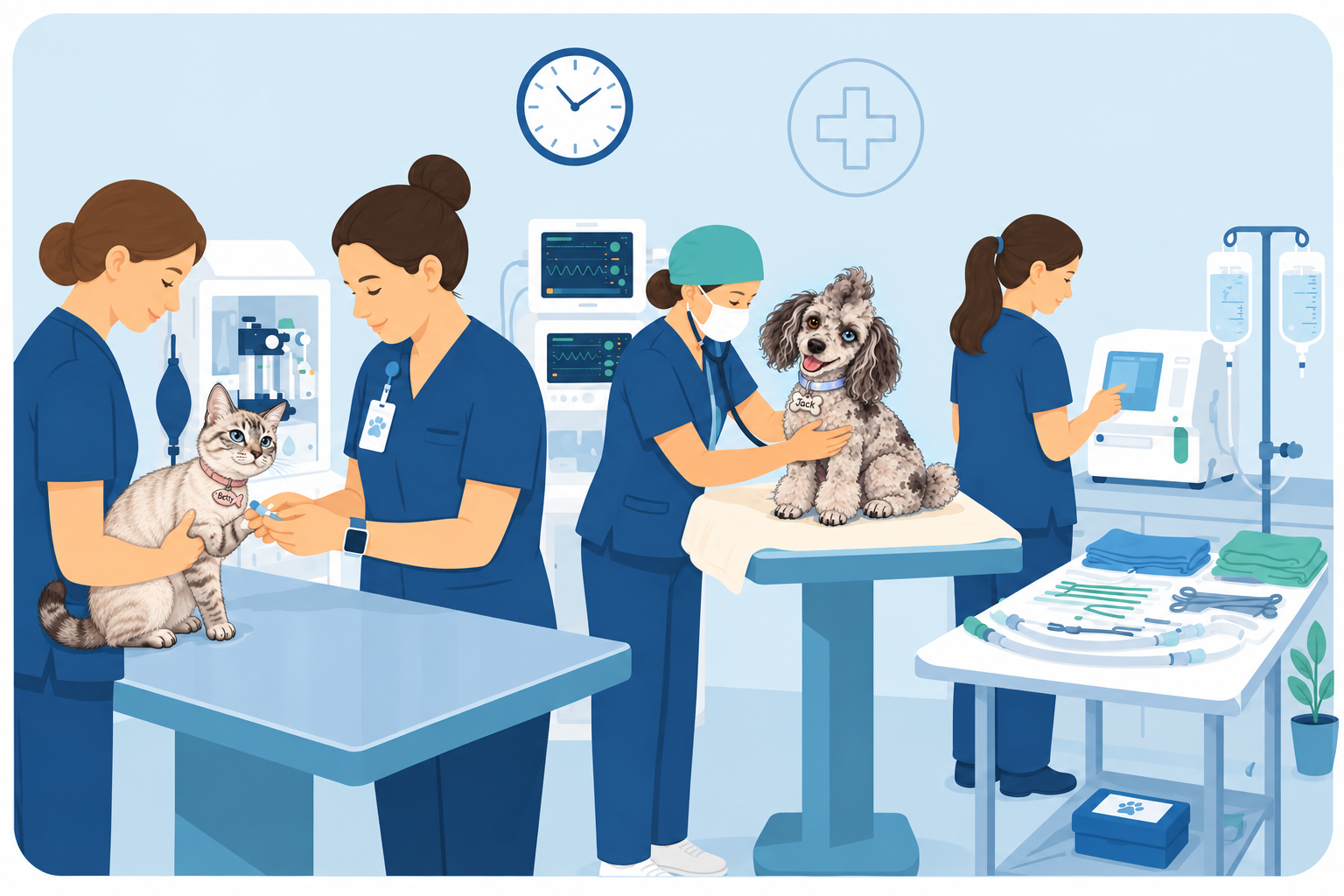
🩺 PREPARING YOUR PET FOR SURGERY: WHAT TO EXPECT
Whether your pet is having a routine spay/neuter or a more involved procedure, careful preparation, anesthesia, and monitoring help keep your pet safe and comfortable.
BEFORE SURGERY
- Follow the fasting instructions.
- Unless instructed otherwise, no food, treats, or water after midnight.
- Instructions may vary based on your pet, medications, age, and procedure.
- Give medications only as instructed.
- Tell us about all medications and supplements.
- Some medications may need to be adjusted or withheld before anesthesia.
- If medication must be given with food, use only a small amount as directed.
- 💊 Pre-visit sedation
- Especially helpful for anxious, fearful, or aggressive pets, particularly cats.
- A strange environment, handling, and being placed in a kennel can be overwhelming.
- We may recommend trazodone or gabapentin to help your pet relax.
- Think of it as a “chill pill,” not a medication to knock them out.
- Depending on the medication, it may be given:
- The night before
- About 2 hours before leaving for the hospital
- And/or every 8–24 hours as directed.
- Do not wait until you arrive at the hospital.
- Your pet may already be too stressed for it to work as well.
- A calmer pet means less stress, less struggling, and safer handling.
- Tell us about any pre-existing medical conditions.
- Even if they seem unrelated to surgery.
- Tell us about any allergies or previous reactions or complications with anesthesia or medications.
- Let us know if your pet is sick before surgery:
- Including: vomiting, diarrhea, coughing, sneezing, lethargy, or other signs of illness.
- Surgery may need to be postponed for safety.
- Your pet will receive a pre-surgical physical examination.
- Pre-anesthetic blood work may be performed.
- To evaluate organ function and identify potential risks.
- We create an individualized anesthesia and pain-management plan based on your pet's age, weight, health, and procedure.
🏥WHY DO WE ASK YOU TO DROP YOUR PET OFF EARLY?
Why drop your pet off at 8 a.m. if surgery isn't until later?
It's a fair question! The time before surgery is an important part of keeping your pet safe, comfortable, and prepared for anesthesia.
Before the Procedure
Once your pet arrives, our veterinary team will:
- Perform a complete physical examination, including assessment of heart rate, breathing, temperature, hydration, and overall health.
- Review your pet's medical history and medications.
- Perform pre-anesthetic blood work, when indicated.
- Create an individualized anesthesia and pain-management plan.
- Place an IV catheter and calculate appropriate fluid rates and medications.
- Prepare the appropriate breathing equipment and endotracheal tube.
- Administer pre-anesthetic medications and allow enough time for them to take effect, providing sedation and pain control for a smoother, safer anesthesia experience.
- Monitor your pet for any unexpected or adverse reactions before proceeding with surgery.
- If a significant reaction or unexpected concern occurs, the procedure may need to be postponed or stopped to protect your pet's safety.
During the Procedure
Once your pet is safely anesthetized, we:
- Place the breathing tube and provide oxygen and anesthesia.
- Carefully prepare and disinfect the surgical area.
- Continuously monitor vital signs, including heart rate, breathing, oxygen levels, blood pressure, and temperature.
Believe it or not, the procedure is often the shortest part of the whole process.
After Surgery
Your pet is closely monitored throughout recovery. We stay with them until they are awake enough for the breathing tube to be safely removed and continue monitoring until they are stable.
Before going home, we:
- Assess recovery and comfort.
- Provide an appropriate E-collar/cone when needed.
- Prepare and review go-home medications and instructions.
- Explain what to expect during recovery and when to contact us.
❤️ Why Arrive So Early?
We strive to provide low-stress, individualized care. Early admission gives our team enough time to complete each step carefully rather than rushing through preparation.
It also allows your pet time to settle into the hospital environment, especially if they are nervous or anxious.
Most importantly, it gives our team enough time after the procedure for a smooth and uneventful recovery, allowing us to closely monitor your pet as they wake up from anesthesia and make sure they are stable, comfortable, and ready to go home.
Your pet is not simply a time slot on the surgery schedule. Every patient receives an individualized evaluation and anesthesia and pain-management plan, along with careful preparation, monitoring, and recovery.
⭐ Early Drop-Off = More Time for Safety, Preparation & Personalized Care
The surgery may happen later in the day, but your pet's care begins the moment they walk through our doors.
🏠 RECOVERY AT HOME
Most pets go home the same day with instructions for:
- Rest and activity restriction
- Medications and pain control
- Feeding and water
- Incision care
- E-collar use
- Follow-up appointments
For the first few days, keep your pet quiet and restrict running, jumping, stairs, and rough play as instructed by your veterinary team. Prevent licking or chewing at the incision.
Preparing for your pet’s recovery? Explore some of our recommended surgery care products below.
❤️ E-COLLAR USE
If an E-collar is recommended for your pet, please use it!
Licking, chewing, or scratching at the incision can cause irritation, infection, delayed healing, or even cause the incision to open and require another surgery.
It may take your pet about 24 hours to get used to the E-collar. The first few hours can be frustrating and stressful.
- Keep your pet in a safe, open area where they cannot get stuck or hurt themselves.
- Supervise them closely during the first few hours.
- Most pets adjust and become much more comfortable with it within a day.
The E-collar protects the incision from this repeated licking trauma and allows it to heal faster and more comfortably.
- Keep the E-collar on at all times unless we tell you otherwise.
- You may briefly remove it while your pet eats or drinks, as long as you are directly supervising them.
- If you are watching your pet closely and can immediately prevent them from licking or chewing the incision, it may be removed briefly.
- Otherwise, keep the E-collar on until we tell you it is safe to stop using it.
Even a few minutes of unsupervised licking can cause significant irritation or damage to a healing incision.
🩺 AFTER SURGERY RECHECK
We recommend a recheck 10–14 days after surgery, even if your pet does not have visible sutures that need to be removed.
At this visit, we will:
- Check the incision to make sure it is healing properly.
- Look for any signs of infection, swelling, or other complications.
- Remove any sutures that need to be removed.
- Confirm that it is safe to stop using the E-collar and gradually return to normal activity.
🚨 CONTACT YOUR VETERINARIAN IF YOU NOTICE:
- Significant bleeding or discharge from the incision
- Increasing redness, swelling, or opening of the incision
- Persistent vomiting or diarrhea
- Difficulty breathing
- Severe or uncontrolled pain
- Extreme weakness or difficulty waking
- Your pet refuses food or water or is unable to keep food or water down
- Any sudden or concerning change in your pet's condition
⚠️Never give human pain medications or other medications unless specifically instructed by your veterinarian.
❤️BEFORE YOU LEAVE
Make sure you understand:
- Which medications to give and when
- How much to feed, when to feed, and whether your pet should receive dry or wet food
- What activity is allowed
- How to care for the incision
- When your pet needs a recheck
- Which signs require immediate veterinary attention
We want you to feel comfortable and prepared.
If you have questions or concerns during your pet's recovery, please contact us—we're here to help.
🛒 RECOMMENDED SURGERY CARE PRODUCTS
The right supplies can help make your pet’s recovery more comfortable and support safe healing at home. We’ve selected surgery care products that may be helpful during your pet’s recovery.
🌐 View Our Recommended Surgery Care Products
Remember: These products are intended to support your pet’s recovery but do not replace the post-operative instructions provided by your veterinarian. If you have concerns about your pet’s recovery or incision, please contact your veterinary team.
❓HAVE MORE QUESTIONS?
We’re here to help you keep your furbaby happy, healthy, and thriving! ❤️
For additional pet health information, visit Veterinary Partner by VIN—a trusted resource with veterinarian-written articles.
🔎 Tip: Search “VIN + your question” on Google for easier results, as the website’s search feature can be a little tricky.
📞 And remember, calling us is always free!
If you have questions or concerns about your pet, please don’t hesitate to reach out. We’re happy to help. 🐾