Vomiting & Diarrhea in Dogs & Cats
Learn what to do when your pet is vomiting or has diarrhea, how to safely manage mild cases at home, and when these symptoms require veterinary care.
Dr. Sofia Raldiris
DVM
VOMITING & DIARRHEA IN DOGS & CATS
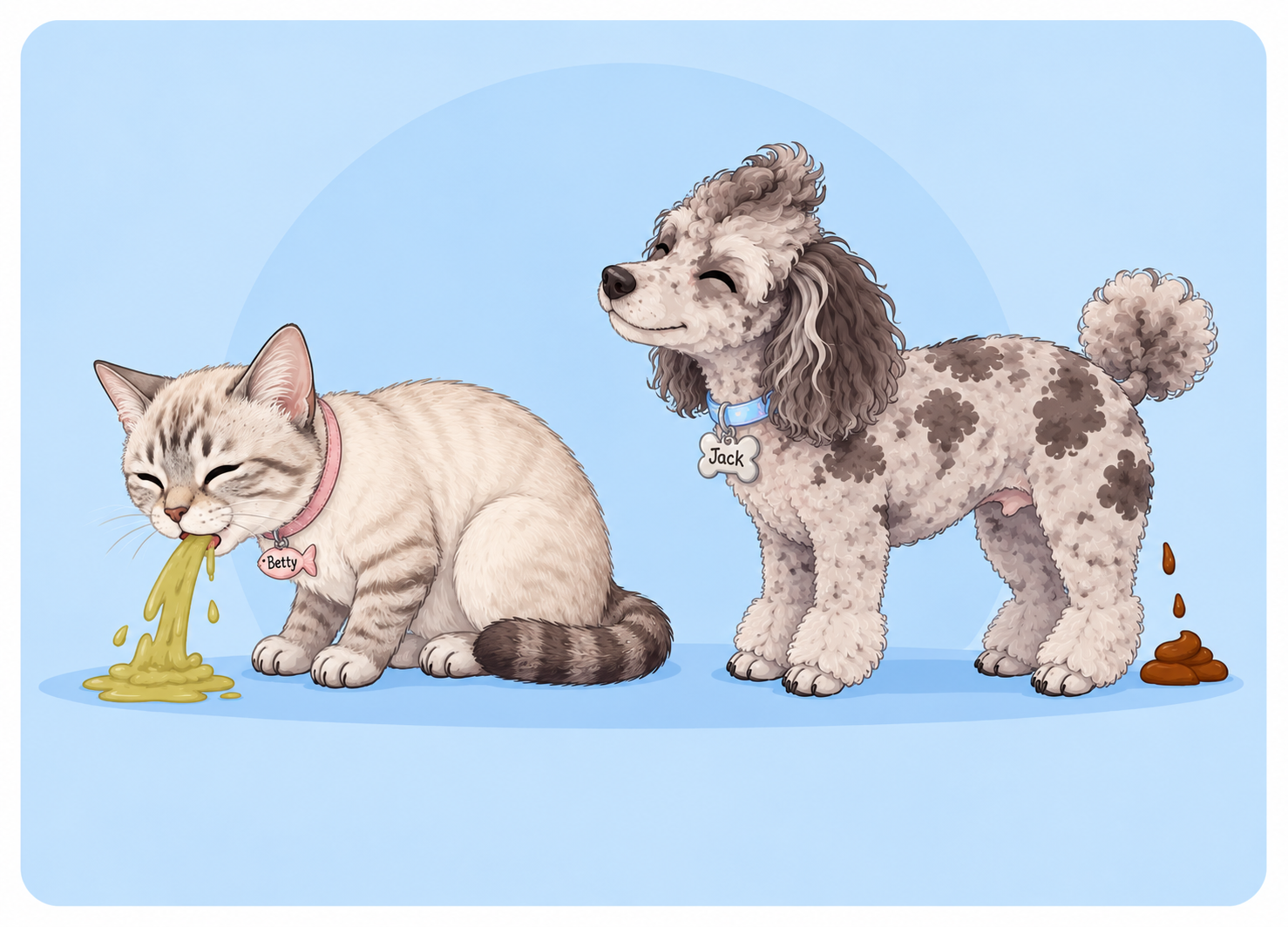
Vomiting and diarrhea are common in dogs and cats, but they can have many different causes—from a simple stomach upset to a serious illness.
⭐ When in doubt, contact your veterinarian.
Puppies, kittens, senior pets, and pets with other medical conditions can become dehydrated or seriously ill quickly.
🤢 WHAT TO DO IF YOUR PET IS VOMITING
If your pet is repeatedly vomiting, acting sick, or you are concerned, seek veterinary care promptly.
If your pet is otherwise bright and stable and has vomited only once:
- Do not offer food for 4–6 hours to allow the stomach to rest.
- Once vomiting has stopped for a few hours:
- Offer 1 teaspoon of water per pound of body weight every 2–3 hours.
- If your pet keeps it down for several hours, gradually increase the amount.
- If there is no vomiting for 6–8 hours, begin offering small, frequent meals 4–6 times a day.
- Do not force food or water.
- If vomiting returns, stop feeding and contact your veterinarian.
🚫WHAT NOT TO DO
Do not give over-the-counter or prescription medications unless specifically instructed by your veterinarian.
Some human medications can be dangerous or toxic to pets.
💩 WHAT TO EXPECT WITH DIARRHEA
Diarrhea can take a few days to completely resolve, even when your pet is otherwise feeling well.
With supportive care, diarrhea should generally start improving within 3–5 days.
- If the diarrhea is about the same or gradually improving, continue to monitor your pet.
- If the diarrhea is getting worse, contact your veterinarian.
- Contact us if the diarrhea is not improving within 3–5 days.
- Straight liquid diarrhea, a significant increase in blood, or a sudden change in the amount or frequency of diarrhea are reasons to contact your veterinarian sooner.
🩸Blood in the Stool
A small amount of bright red bloodcan occur with diarrhea and may be less concerning if your pet is eating, drinking, and acting normally.
Inflammation of the gastrointestinal tract can cause small amounts of blood to leak into the stool.
Increasing or large amounts of blood, black/tarry stool, or blood accompanied by vomiting, weakness, poor appetite, or lethargy requires veterinary attention.
🚽 What If My Pet Does Not Poop?
It can be normal for a pet to go 3–5 days without a bowel movement after an episode of vomiting and diarrhea.
After diarrhea, there may simply be less stool in the intestines, and the remaining stool needs time to form.
You can continue to monitor your pet as long as they are:
- Eating and drinking normally
- Comfortable
- Not straining to defecate
- Otherwise acting normally
If your pet is repeatedly straining and nothing is coming out, contact your veterinarian.
🍗 DIET, PROBIOTICS & SUPPORTIVE CARE
For uncomplicated vomiting and diarrhea in an otherwise stable, hydrated pet, dietary management, hydration, and probiotics are the foundation of supportive care.
A veterinary gastrointestinal (GI) diet is preferred when available. These diets are highly digestible and typically low in fat, making them easier on the digestive system while your pet recovers.
⭐ Our Recommended GI Diets
- Royal Canin Gastrointestinal
- Hill’s Prescription Diet i/d
- Hill’s Prescription Diet Gastrointestinal Biome
- Purina Pro Plan Veterinary Diets EN Gastroenteric
⭐ Think of a GI diet as a short-term recovery diet—not a permanent diet.
🏠 If a GI Diet Is Not Available
You can temporarily use:
- Dogs: Plain, boiled, skinless, unseasoned chicken breast or lean ground turkey with white rice. Drain excess fat from the turkey.
- Cats: Plain, boiled, skinless, unseasoned chicken breast or plain boiled white fish, such as cod.
Bland diets are for short-term use only, generally 2–5 days. They are not nutritionally complete for long-term feeding.
Once vomiting has resolved and stools are normal, gradually transition your pet back to their regular diet as directed by your veterinarian.
Cats should not go without food for prolonged periods. If your cat is not eating, contact your veterinarian.
🦠 WHAT ABOUT PROBIOTICS?
Your veterinarian may recommend an evidence-based veterinary probiotic or synbiotic, such as Proviable.
Probiotics support a healthy balance of bacteria in the gastrointestinal tract and may help diarrhea resolve faster.
⭐ Our Recommended Probiotics
- Proviable Probiotic + Paste — particularly useful for acute diarrhea
- Purina Pro Plan FortiFlora
- Visbiome
💊 WHY NOT ANTIBIOTICS?
Antibiotics, including metronidazole, are not routinely recommended for uncomplicated diarrhea in stable pets. Studies show that metronidazole does not consistently shorten diarrhea and may disrupt the normal gut microbiome.
GI diet + hydration/supportive care + probiotics is preferred over routine antibiotics for most stable pets with uncomplicated vomiting and diarrhea.
Antibiotics may still be appropriate when there is evidence of a specific bacterial infection or your pet is systemically ill.
⭐ When to Call Us
With appropriate supportive care, diarrhea should start improving within 3–5 days. If your pet's stool is not improving within that time—or is getting worse at any point—contact your veterinarian.
🛒 Looking for nutrition products to support your pet’s digestive health? Explore some of our recommended options below.
🚨 WHEN TO CONTACT YOUR VETERINARIAN
Contact your veterinarian promptly if your pet:
- Continues vomiting or cannot keep water down
- Repeatedly tries to vomit but nothing comes up
- Has increasing or large amounts of blood in the stool or vomit
- Has black, tarry stool
- Has straight liquid diarrhea or diarrhea that is getting worse
- Has a painful, swollen, or distended abdomen
- Becomes weak, very lethargic, or collapses
- Shows signs of dehydration
- Stops eating for more than 24 hours—or sooner if your pet is a cat, puppy, kitten, has diabetes, or has another medical condition
- May have eaten a toxin, medication, foreign object, bone, or other inappropriate item
- Has diarrhea that is not improving within 3–5 days
- Gets worse at any time
🩺 Your pet may need additional treatment.
Depending on the underlying cause, your veterinarian may recommend:
- IV fluids
- Blood work
- X-rays
- Ultrasound
- Hospitalization
- Additional treatment
The treatment needed will depend on the underlying cause.
🏠 HOME CARE AFTER YOUR VETERINARY VISIT
🕐The First 24 Hours
🛏️Rest
- Keep your pet indoors, quiet, and comfortable.
- Restrict vigorous activity while recovering.
💊Medications
- Give all medications exactly as prescribed.
- If your veterinarian prescribed an anti-nausea medication:
- Follow their specific instructions regarding food and other medications.
- Unless instructed otherwise, give the anti-nausea medication first, then wait approximately 1 hour before offering food, water, or other medications by mouth.
- If your pet vomits after receiving medication or cannot keep medications down, contact your veterinarian. Injectable medications or hospitalization may be necessary.
💧 Food & Water
- Offer small amounts frequently rather than a large meal or a full bowl of water at once.
- Gradually increase food and water as your pet improves.
- Do not force food or water.
- A veterinary gastrointestinal diet is preferred. If one is not available, see the Temporary Food Options above.
🩺 If your veterinarian recommends a prescription GI diet:
- Feed the prescription diet until vomiting has completely resolved and stools have returned to normal.
- Continue the diet for 3–7 days after symptoms have resolved, or as directed by your veterinarian.
Transition Back to Regular Food
Once your pet has had normal, firm stools for at least 3 consecutive days, gradually transition back to their regular diet over 7–10 days:
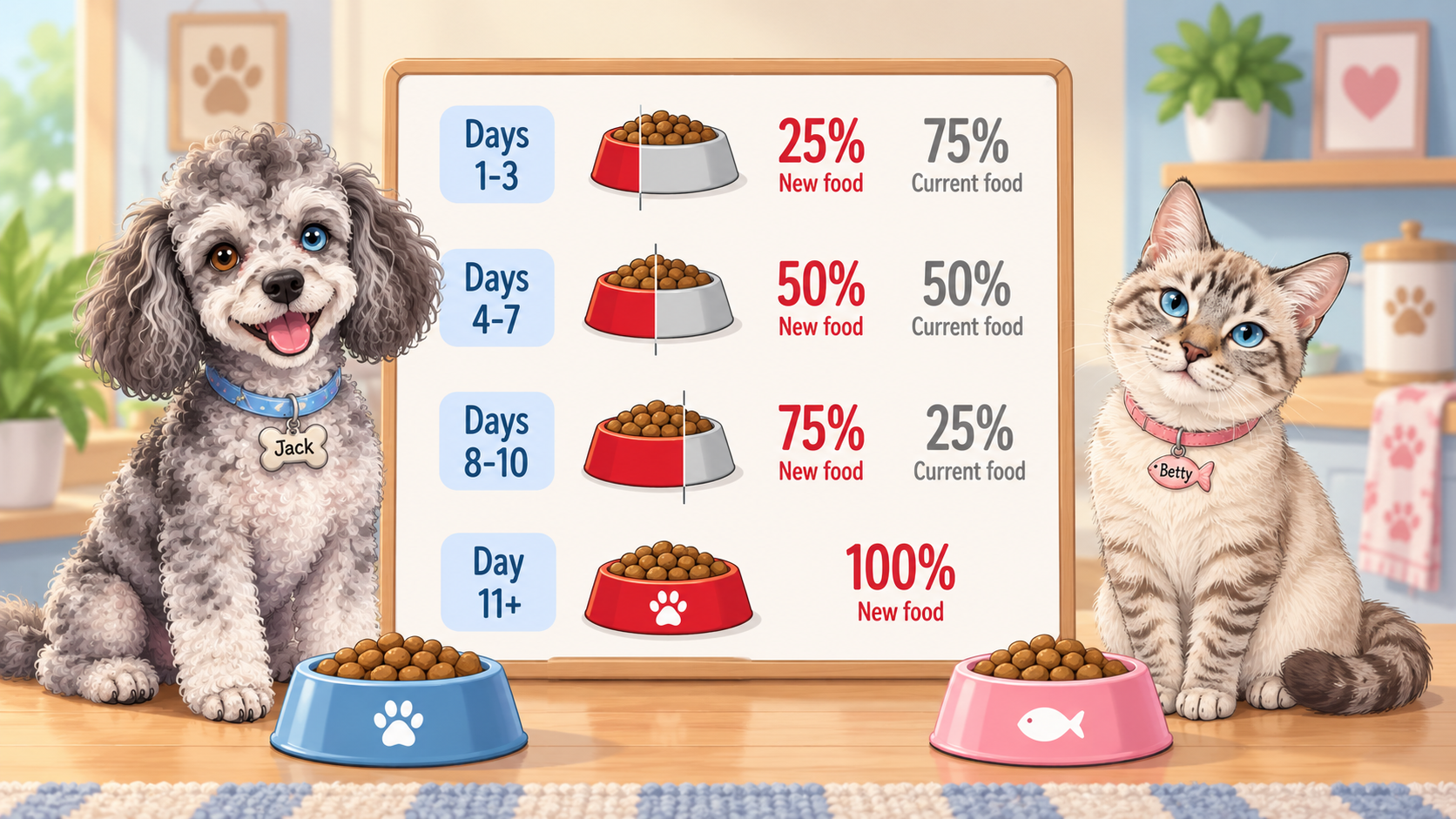
⚠️ If symptoms return: Return to the GI diet and contact your veterinarian if symptoms persist.
🕐 THE SECOND 24 HOURS
If your pet is improving:
- Continue all medications as prescribed.
- Continue small, frequent meals.
- Gradually increase food and water.
- Slowly return to normal activity.
❤️ REMEMBER
Vomiting and diarrhea are symptoms, not diagnoses.
They can be caused by something as simple as a dietary upset or something much more serious.
⭐ Vomiting is generally more concerning than diarrhea, especially when it is repeated or your pet cannot keep water down.
⭐ If your pet is getting worse, developing concerning symptoms, or not improving within the expected timeframe, contact your veterinarian.
🛒 RECOMMENDED NUTRITION & DIGESTIVE HEALTH PRODUCTS
Certain nutrition products may help support your pet’s digestive health during recovery from mild gastrointestinal upset. We’ve selected products that may be useful additions to your pet’s nutritional and digestive care routine.
🌐 View Our Recommended Nutrition & Digestive Health Products
Remember: These products are intended to support digestive health and do not replace veterinary evaluation or treatment. If vomiting or diarrhea is severe, persistent, or accompanied by other concerning signs, contact your veterinarian.
❓HAVE MORE QUESTIONS?
We’re here to help you keep your furbaby happy, healthy, and thriving! ❤️
For additional pet health information, visit Veterinary Partner by VIN—a trusted resource with veterinarian-written articles.
🔎 Tip: Search “VIN + your question” on Google for easier results, as the website’s search feature can be a little tricky.
📞 And remember, calling us is always free!
If you have questions or concerns about your pet, please don’t hesitate to reach out. We’re happy to help. 🐾