Allergies & Recurring Ear & Skin Infections in Dogs & Cats
Learn about the most common causes of allergies in dogs and cats, how they are diagnosed, and the options available to control itching, prevent infections, and keep your pet comfortable.
Dr. Sofia Raldiris
DVM
ALLERGIES & RECURRING EAR & SKIN INFECTIONS IN DOGS & CATS
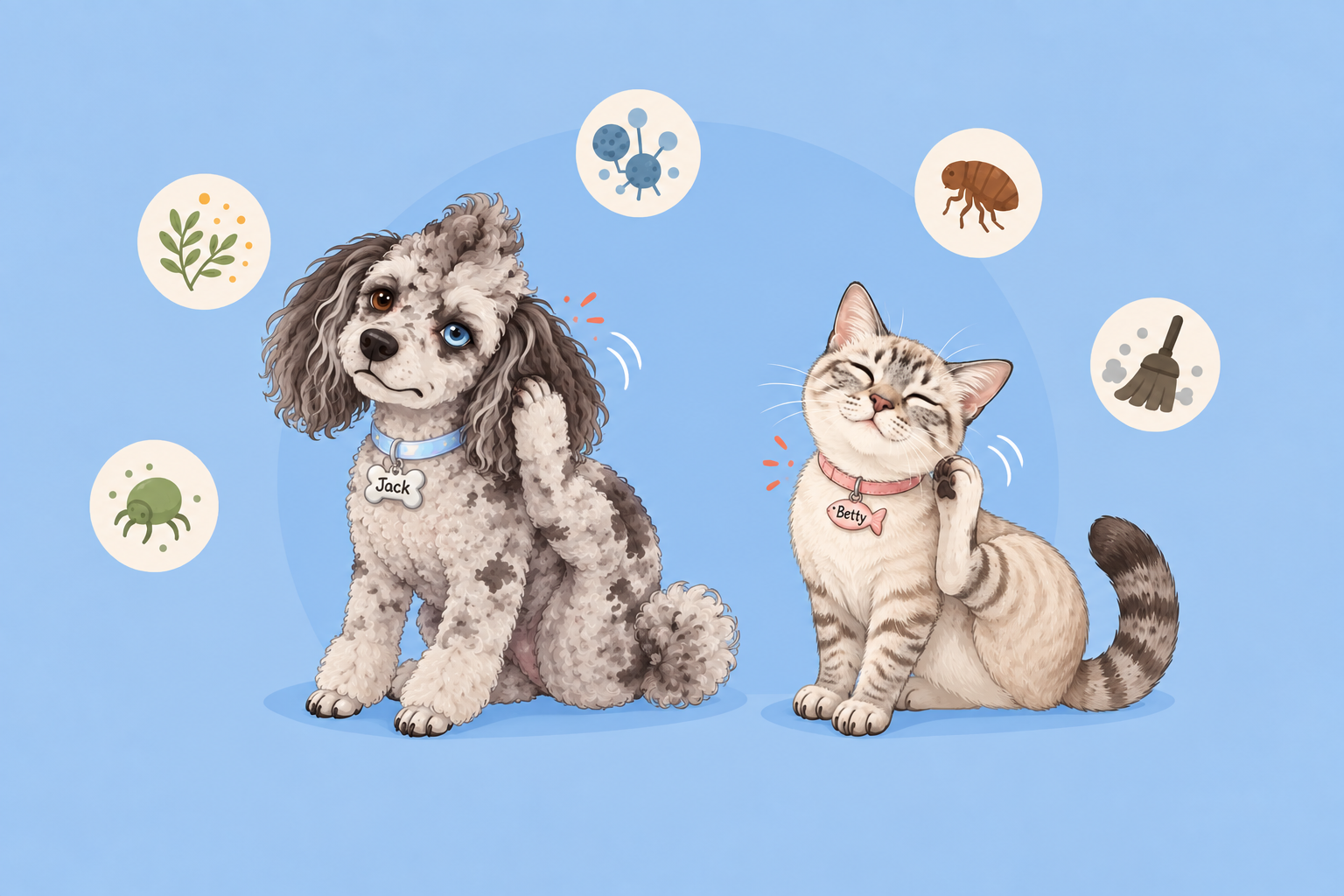
Allergies are a common cause of itching, skin problems, and recurrent ear infections in dogs and cats.
Allergies can be frustrating because there is often more than one factor involved. Your pet may have more than one type of allergy, and several things can contribute to their symptoms at the same time.
The important thing to understand is that allergies are usually managed—not cured.
⭐ Our goals are to:
- Control itching and inflammation
- Treat secondary infections
- Protect the skin and ears
- Identify and reduce triggers when possible
- Keep your pet comfortable and prevent frequent flare-ups
Occasional flare-ups can still happen even when treatment is working. Do not stop allergy medications without talking to your veterinarian.
🔍 HOW ARE ALLERGIES DIAGNOSED?
There is no single test that tells us whether your pet has allergies.
Your veterinarian will look at your pet's:
- Medical history
- Pattern and location of itching
- Skin and ear examination
- Response to treatment
- Flea exposure
- Possible food triggers
- Environmental triggers
Allergy testing is mainly used after environmental allergies have been diagnosed to identify specific allergens and determine whether allergy immunotherapy (allergy shots or oral therapy) may be helpful.
🪳 FLEA ALLERGY
Flea allergy is one of the most common causes of allergic skin disease.
Some pets are extremely sensitive to flea saliva. Even one or two flea bites can cause significant itching.
You may never see a flea on your pet because allergic pets often groom them away.
⭐ The most important step: use consistent, year-round flea prevention.
If your pet has a flea allergy, every pet in the household may need treatment, and the environment may also need to be addressed.
🌐 Learn More About Year-Round Flea & Parasite Prevention
🌿 ENVIRONMENTAL ALLERGIES
Some pets develop allergies to things in their environment, such as:
- 🌳 Pollen
- 🌱 Grass
- 🍂 Weeds
- 🦠 Mold
- 🏠 Dust mites
Environmental allergies are often chronic and may require long-term management.
Your pet may have seasonal flare-ups, or symptoms may occur year-round.
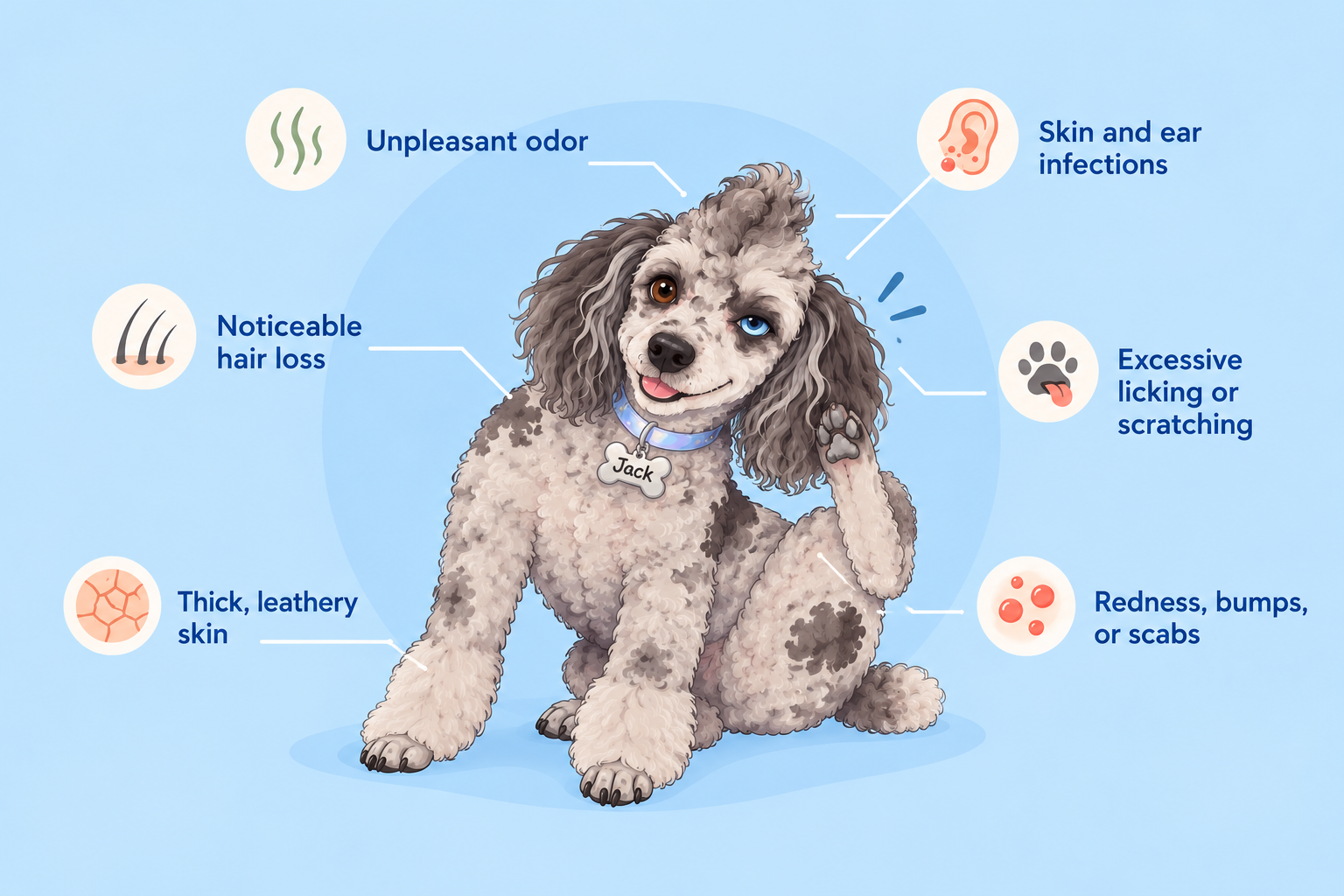
Common signs include:
🍗 FOOD ALLERGIES
Food allergies occur when the immune system reacts to an ingredient in the diet, usually a protein, such as:
- Chicken
- Beef
- Pork
- Dairy
- Other protein sources
A pet can develop a food allergy even after eating the same food for years.
Food allergies are more likely when your pet has:
- Itching throughout the year
- Recurrent ear infections
- Recurrent skin infections
- Vomiting or diarrhea
🍽️ How do you test for a food allergy?
The most reliable method is a strict elimination diet trial.
Your veterinarian may recommend a prescription hydrolyzed-protein diet, which is preferred for a true food-allergy trial.
⭐ Preferred diets:
- Royal Canin® Hydrolyzed Protein
- Hill's Prescription Diet® z/d
- Purina Pro Plan Veterinary Diets HA Hydrolyzed
These diets contain proteins that have been broken down into very small pieces, making them less likely to trigger an allergic reaction.
⏱️ The 8-Week Trial
Once your pet is fully transitioned: The diet must be fed STRICTLY for approximately 8 weeks.
Even small amounts of other foods can interfere with the trial.
That means NO:
- Treats
- Table food
- Chews
- Flavored medications
- Supplements containing other proteins
- Other foods
🛒 Looking for products to support your pet’s skin and coat health? Explore some of our recommended options below.
💰 A Less Ideal OTC Option
If a prescription diet is not possible, an over-the-counter limited-ingredient diet may be considered such as:
Purina Pro Plan® Sensitive Skin & Stomach — Salmon & Rice
⚠️ Important: OTC diets are less reliable for diagnosing food allergies than prescription elimination diets. They may contain trace amounts of other proteins due to manufacturing cross-contamination.
If your pet does not improve on an OTC diet trial, this does not rule out a food allergy. Your veterinarian may recommend a prescription hydrolyzed diet before making a final determination.
➔ After The Elimination Trial
If your pet improves on the elimination diet, your veterinarian may recommend reintroducing the previous diet to confirm the diagnosis.
Blood, saliva, and commercial "food allergy tests" are not reliable ways to diagnose food allergies.
🦠 ALLERGIES CAN CAUSE SKIN & EAR INFECTIONS
🛁 The Skin
Allergies cause inflammation and damage the skin's protective barrier.
This allows normal bacteria and yeast living on the skin to multiply.
The frustrating cycle: Allergy → Itching → Skin damage → Infection → More itching
Secondary infections can involve:
- 🦠 Bacteria — commonly Staphylococcus
- 🍞 Yeast — commonly Malassezia
Pets may also develop hot spots from excessive licking, scratching, and chewing.
⭐ Treating the infection AND controlling the underlying allergy are both important.
Your veterinarian may recommend skin cytology to determine whether bacteria or yeast are present.
👂 The Ears
Recurrent ear infections are often linked to underlying allergies.
Allergies cause inflammation inside the ear canal, creating an environment where yeast and bacteria can overgrow.
Over time, chronic inflammation can cause the ear canal to become thickened, narrowed, and eventually calcified. In severe end-stage ears, surgery such as a otal ear canal ablation (TECA) may be necessary.
Watch for:
- Head shaking or scratching at the ears
- Redness, odor, discharge
- Pain
- Frequent ear infections
Don't just keep treating the infection.
If your pet has recurring ear problems, your veterinarian should perform an otoscopic examination and ear cytology.
Finding and managing the underlying cause is what helps break the cycle.
⭐ Important: Avoid Q-tips and human or OTC ear products unless recommended by your veterinarian. If the eardrum is damaged, some products can cause serious complications.
✂️ Ear hair & Plucking
Ear plucking is a double-edged sword.
Some dogs have excessive ear hair that traps debris and makes the ear canal difficult to examine or treat. In these cases, your veterinarian may recommend removing some hair.
However, plucking can also cause inflammation and contribute to ear infections.
⭐ Have the ear examined BEFORE plucking.
If the ear canal can be properly visualized: routine ear-hair plucking is generally NOT recommended.
For many dogs, trimming the hair around the ear opening is enough.
The goal isn't to remove all the hair—the goal is a healthy ear.
💊 TREATING ALLERGIES
There is no single treatment that works for every pet.
Treatment usually involves a combination of:
1. Control Itching & Inflammation
Depending on your pet, treatment may include:
Apoquel (oclacitinib) - Dogs
- JAK inhibitor that reduces itching and inflammation in dogs
- Works relatively quickly
- When starting or restarting: given twice daily for 14 days, then once daily
- Generally well tolerated
- Does not directly cause cancer, but may worsen existing tumors or other neoplastic conditions
Zenrelia (ilunocitinib) - Dogs
- JAK inhibitor for allergic itching in dogs
- Given once daily from the start
Cytopoint (lokivetmab) - Dogs
- Injection that specifically targets an important itch signal in dogs
- Often starts working within 24 hours
- Relief commonly lasts about 1 month or longer
- Can be repeated as needed
Steroids
- Effective and inexpensive for short-term control
- Can cause significant side effects, especially with long-term use
- May increase thirst, appetite, urination, blood sugar, and risk of infection
Steroids are generally used strategically rather than as the preferred long-term allergy treatment.
Atopica (cyclosporine) - Cats
- Modulates the immune system to control allergic inflammation
- Used frequently in cats
- Can take several weeks to reach full effect
⭐ Sometimes, ONE medication isn't enough!
Some pets need a combination of treatments.
Your veterinarian will determine which medication—or combination—is safest and most appropriate for your pet.
2. Treat Secondary Infections
Anti-itch medications do not treat bacterial or yeast infections.
Depending on the infection, treatment may include:
- Topical medications
- Medicated shampoos or mousses
- Ear medications
- Oral medications when necessary
⭐ Treat infections early.
Waiting can allow infections to become more severe, painful, difficult to treat—and more expensive.
🛁 Skin Care
Regular bathing can help remove allergens from the skin and reduce flare-ups.
For dogs that constantly lick their feet outdoors, booties can also help reduce contact with environmental allergens.
Your veterinarian may recommend a medicated shampoo or mousse containing ingredients such as chlorhexidine, ketoconazole, or miconazole, including:
Dechra MiconaHex + Triz Shampoo or Mousse or Wipes
- Flare-ups: Bathe 2–3 times weekly for 1–2 weeks.
- Leave shampoo on for 10–15 minutes, then rinse well.
- Use as needed for maintenance and future flare-ups.
- For localized problem areas, apply once or twice daily to the affected area, allowing 5–10 minutes of contact time before rinsing.
Paws & muzzle: Wiping or rinsing these areas after outdoor exposure can help remove environmental allergens.
⭐ Important: Do not routinely use dish soap or human skin products on your pet. They can irritate or dry the skin.
🛒 Looking for joint-health products to support your pet’s skin and mobility? Explore some of our recommended options below.
Strengthen the Skin Barrier
Omega-3 fatty acids, particularly EPA and DHA, may help support healthy skin and reduce inflammation
For pets with allergies, I prefer high-concentration omega-3 joint supplements because they provide a higher amount of EPA and DHA and can support both skin and joint health.
Options may include:
Royal Canin
- Joint Dog Supplement Soft Chews for Adult Dogs
Welactin
- Welactin Advanced 3TA for dogs
- Welactin Omega-3 Soft Chews for dogs
- Welactin Canine Omega-3 Soft Gels for dogs
- Welactin Feline Omega-3 Fish Oil for cats
- Welactin Tidbits Chews for cats
Nordic Naturals
- Nordic Naturals Omega-3 Soft Gels for dogs
- Nordic Naturals Omega-3 Fish Oil for dogs
🛒 Looking for joint-health products to support your pet’s skin and mobility? Explore some of our recommended options below.
👂 Ear Care
Pets with allergies may need regular ear care.
Your veterinarian may recommend a routine ear cleaner that helps clean and dry the ear canal, such as:
Dechra EpiKlean or Virbac EpiOtic
- Use once weekly or as directed.
- Use after exposure to water.
For pets experiencing an active ear flare-up, your veterinarian may recommend a medicated cleaner such as:
Dechra MalAcetic Ultra
- Flare-ups: clean both ears once a day for 3-7 days.
- If your pet's ears are not improving within 5–7 days, schedule an appointment, as stronger or prescription treatment may be needed.
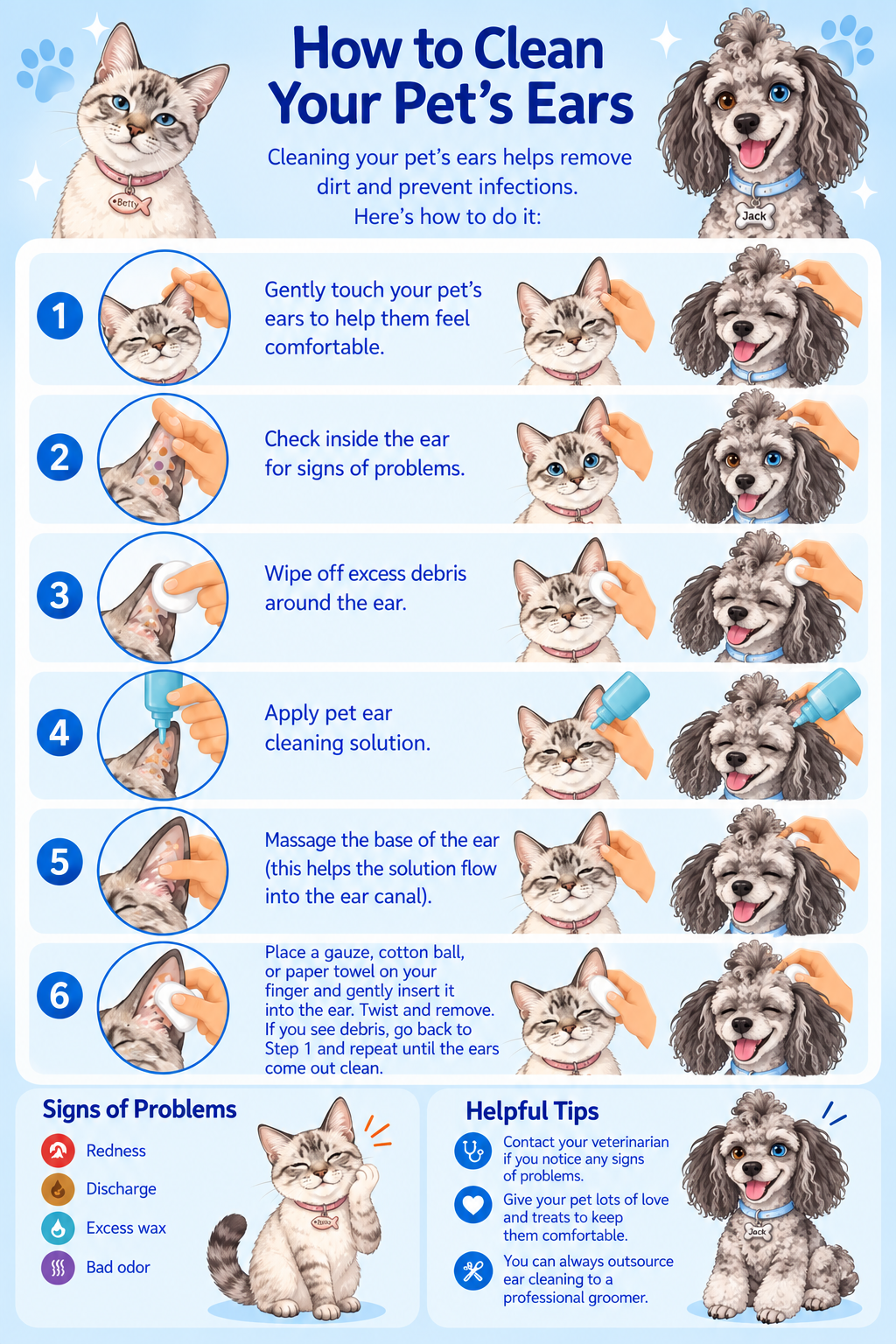
Not every dog needs routine ear cleaning or ear-hair removal.
The right ear-care routine depends on your pet's ear anatomy and individual needs.
⭐ Important: Do not use vinegar, alcohol, hydrogen peroxide, dish soap, or other home remedies in your pet's ears. These products can irritate an already inflamed ear.
🛒 Looking for products to support your pet’s skin and coat health? Explore some of our recommended options below.
💉 ALLERGY TESTING / ALLERGY SHOTS
Allergy testing is primarily used to identify environmental allergens after atopic dermatitis has been diagnosed.
The results can be used to create allergen-specific immunotherapy, such as allergy shots or oral therapy.
Know before you start:
- It is a long-term treatment.
- It can take 6–12 months to see the full benefit.
- Not every pet responds.
- Some pets still need additional itch-control medications.
- It is not an instant cure.
- Flare-ups can still occur even when immunotherapy is working.
⭐ Think of immunotherapy as long-term management—not a quick fix.
💊 WHAT ABOUT ANTIHISTAMINES?
Antihistamines are inexpensive and available over the counter, but they are not consistently effective for allergic itching in dogs and cats.
Your veterinarian may recommend an antihistamine for some pets such as:
- Zyrtec (cetirizine)
- Benadryl (diphenhydramine)
- Claritin (loratadine)
⭐ Never combine these!
⭐ Never give your pet an over-the-counter medication without first confirming the correct product and dose with your veterinarian.
Some combination products contain ingredients that can be dangerous for pets.
🐱 WHAT ABOUT CATS?
Allergies can look very different in cats.
Cats may show:
- Excessive grooming
- Hair loss
- Small scabs or bumps
- Head and neck itching
- Ear problems
- Skin infections
- Increased scratching
Cats can be more challenging to treat because there are fewer treatment options available.
An individualized treatment plan is important.
❤️ THE BOTTOM LINE
Allergies are usually managed, not cured.
The goal is to:
CONTROL THE ITCH → TREAT INFECTIONS → PROTECT THE SKIN & EARS → MANAGE TRIGGERS
And remember:
A flare-up does not automatically mean your allergy medication isn't working.
Do not stop medications on your own. Work with your veterinarian to adjust the treatment plan as your pet's symptoms change.
⭐ One Important Recommendation
Try to work consistently with one veterinarian whenever possible.
Allergy management often requires trial and error and adjustments over time. Repeatedly treating individual infections without investigating why they keep returning can leave you stuck in the same cycle.
If your pet is not improving or you feel you've reached a dead end, ask your veterinarian about a referral to a veterinary dermatologist.
🛒 RECOMMENDED SKIN & COAT PRODUCTS
There are many skin and coat products available for dogs and cats, but not all products provide the same benefits. We’ve selected options that we believe may be helpful additions to your pet’s skin and coat care routine.
🌐 View Our Recommended Skin & Coat Products
Remember: Skin and coat products may help support your pet’s skin health, but they do not treat the underlying cause of allergies. Pets with recurring itching, skin infections, or other allergy-related concerns may need a veterinary evaluation and an individualized treatment plan.
❓HAVE MORE QUESTIONS?
We’re here to help you keep your furbaby happy, healthy, and thriving! ❤️
For additional pet health information, visit Veterinary Partner by VIN—a trusted resource with veterinarian-written articles.
🔎 Tip: Search “VIN + your question” on Google for easier results, as the website’s search feature can be a little tricky.
📞 And remember, calling us is always free!
If you have questions or concerns about your pet, please don’t hesitate to reach out. We’re happy to help. 🐾