Anxiety in Cats
Learn to recognize signs of anxiety in your cat and discover simple ways to help them feel safe, comfortable, and confident.
Dr. Sofia Raldiris
DVM
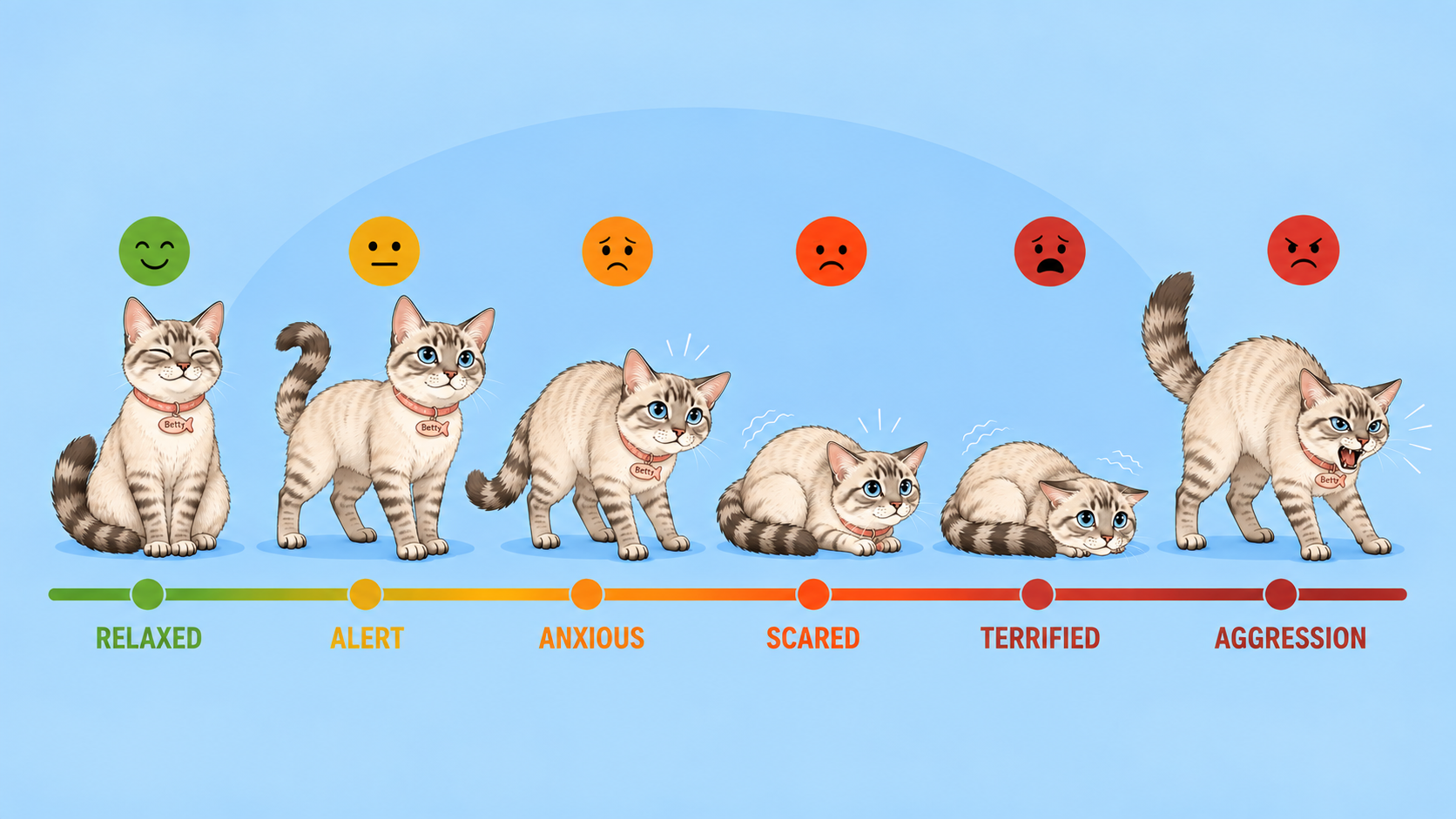
🐱 ANXIETY IN CATS
Cats can be anxious too—and they don't always make it obvious.
Cats are experts at hiding stress and discomfort. Sometimes, the first sign of anxiety is simply that your cat starts acting differently.
Changes in the home, new people or pets, loud noises, moving, changes in routine, or conflict with another cat can all cause stress and anxiety.
A sudden change in behavior should never automatically be blamed on anxiety.
Medical problems can look very similar, so your veterinarian may recommend an exam to rule out an underlying health issue.
SIGNS OF ANXIETY
Your cat may be experiencing stress if you notice:
- Hiding more than usual or avoiding people and other pets
- Personality or behavior changes, including irritability, fear, or aggression
- Increased vocalization, including excessive meowing
- Grooming changes, including excessive grooming, hair loss, or grooming less
- Appetite changes, including eating less or refusing food
- Sleep or activity changes, such as sleeping more, restlessness, or difficulty settling
- Litter box changes, including urinating or defecating outside the litter box or urine marking
- Weight loss
- Signs of pain or discomfort
- Changes that don't improve after reducing stress or making environmental changes
⭐ Pay attention to what is normal for YOUR cat.
Cats don't always look obviously anxious. Even small changes in their normal behavior can be important clues.
⚠️ A cat that stops eating needs attention.
Cats can become seriously ill when they stop eating.
Contact your veterinarian promptly if your cat refuses food, especially if this continues for 24 hours.
🚨 Urinary problems can be an emergency.
If your cat is:
- Straining to urinate
- Making frequent trips to the litter box
- Crying while trying to urinate
- Producing very little or no urine
Contact a veterinarian immediately.
This is especially important in male cats, because urinary obstruction can become life-threatening.
🌐 Learn More About Urinary Blockage in Cats
🏠 CREATE A SAFE SPACE
Cats feel more secure when they have a quiet place where they can hide, rest, and get away from things that make them uncomfortable.
Try providing:
- 🐾 Cat trees or elevated resting areas
- 🏠 Hiding places or covered beds
- 🛏️ Comfortable sleeping areas
- 🪵 Scratching posts
- 🧸 Toys and food puzzles
- 🤫 Quiet areas away from busy household activity
❤️ Let your cat hide.
Never force a hiding cat out of their safe space.
Being able to retreat somewhere safe can actually help your cat feel more confident.
Make the safe haven a positive, disturbance-free space by offering treats, enrichment, and meals there. If you need to interact with your cat, do so away from the safe haven so they always have somewhere to retreat.
🛒Looking for products to help support your cat’s comfort and stress management? Explore some of our recommended options below.
❤️ REDUCE STRESS AT HOME
Cats generally do best when life is predictable and consistent.
Try to:
- Keep feeding and play times consistent
- Introduce changes gradually
- Let your cat approach you instead of forcing interaction
- Provide escape areas when they feel overwhelmed
- Reward calm, confident behavior
- Avoid yelling, punishment, or physical correction
⭐ Don't punish anxiety.
Punishment can increase fear and stress and may make the behavior worse.
Instead, focus on helping your cat feel safe and in control.
🐈 Multi-Cat Households
Conflict between cats is a very common source of chronic stress.
Even cats that don't physically fight may be stressed if one cat is blocking another cat's access to food, water, litter boxes, resting areas, or other important resources.
⭐ Give each cat options.
Provide multiple:
- 🍽️ Food stations
- 💧 Water stations
- 🚽 Litter boxes
- 🛏️ Resting areas
- 🪵 Scratching posts
- 🏠 Hiding places
- 🌳 Elevated spaces
🚨 Spread resources out.
Don't put everything in one area. Separate resources make it harder for one cat to control access to everything.
If your cats are fighting, don't force them to interact. They may need to be separated and gradually reintroduced with guidance from your veterinary team.
🧸 Enrichment: Let Your Cat be a Cat!
Cats need daily opportunities to perform their natural feline behaviors, including hunting, chasing, pouncing, climbing, scratching, exploring, and foraging.
Try:
- Wand and interactive toys
- Food puzzles
- Cat trees and scratching posts
- Treat hunts around the house
- Toys that encourage chasing and pouncing
⭐ Daily interactive play matters.
Regular play can help reduce boredom and stress while giving your cat an appropriate outlet for their natural behaviors.
🚽 Litter Box Stress
Stress and anxiety can contribute to urinating outside the litter box—but medical problems should always be ruled out first.
⭐ Remember: 1 litter box PER cat + 1 extra
Cats generally prefer:
- Unscented, clumping, low-dust litter
- Large litter boxes
- Quiet, easily accessible locations
- Clean litter boxes
Whenever possible, avoid putting all the litter boxes together in one location.
🌐Learn More About Urinary Tract Disease in Cats
🛒Looking for products to help support your cat’s comfort and stress management? Explore some of our recommended options below.
🩺 CAT ANXIETY AT THE VETERINARIAN
Your cat may be sweet, calm, and completely relaxed at home, but the veterinary hospital is a very different environment.
🧠 Fear —> Fight or Flight —> Aggression
The carrier, car ride, unfamiliar smells and sounds, people and animals, and medical handling can trigger a strong fight-or-flight response. Even a normally friendly cat may become fearful and react defensively when they feel they cannot escape.
There are things you can do before and during the visit to make the experience easier.
🐾 Start With The Carrier
Leave the carrier open and accessible at home rather than bringing it out only on appointment day.
Make it inviting with:
- A familiar blanket, bed, or toy
- Treats or toys near and inside the carrier
- Meals near the carrier
- Opportunities to enter and leave freely
🚗 Make The Trip Less Stressful
Once your cat is comfortable with the carrier, gradually introduce short car trips.
During travel:
- Keep the carrier secure and cover it with a light towel or blanket if this helps your cat feel safer
- Keep the car quiet and comfortable
- Avoid unnecessary stops or long trips
- Never open the carrier during the car ride, even if your cat is vocalizing
- Consider using a pheromone spray inside the carrier before leaving home, following the manufacturer's directions
💊 Ask About Pre-Visit Medication
If your cat becomes very anxious at the veterinarian, talk to your veterinary team before the appointment.
Pre-visit medication is not meant to “knock out” your cat so we can get things done. It works best when given before anxiety and the fight-or-flight response take over.
Your cat may seem very sleepy or relaxed at home after receiving it. This does not necessarily mean it is too strong. Once at the hospital, unfamiliar smells, sounds, people, animals, and handling can quickly increase anxiety, making the calming effect seem less noticeable.
Our goal is to reduce fear and minimize excessive restraint—not simply make your cat sleepy enough to complete the appointment.
Reducing fear today can help prevent defensive aggression and make future veterinary visits easier.
We use the least stressful approach possible, including time, treats, distraction, gentle handling, choices when possible, and medication or sedation when medically appropriate.
Sometimes the kindest and safest choice is to pause, change our approach, use additional medication, or reschedule rather than force a procedure.
🌿 PHEROMONES & CALMING SUPPORT
Pheromones may help some cats feel more comfortable during stressful situations and can be used before and during veterinary visits.
Recommended products:
- Feliway Diffuser — for use at home
- Feliway Spray — for the carrier and car ride
- Calming patches — for travel and other stressful situations
Pheromones may be useful for moving or home changes, introducing a new pet, multi-cat tension, travel, urine marking, and other stressful situations. Follow the manufacturer's directions for proper use.
🧸Calming Supplements
Some cats may benefit from supplements or probiotics designed to support calm behavior, such as:
- Purina Calming Care
- VetriScience Composure Pro
⏳ Be patient.
These products are generally supportive rather than a cure for anxiety and may take 4-8 weeks to show their full benefit.
Pheromones and supplements do not replace environmental changes, enrichment, training, behavior modification, or appropriate medical treatment.
🛒Looking for products to help support your cat’s comfort and stress management? Explore some of our recommended options below.
🍽️ VETERINARY PRESCRIPTION DIETS
Some cats may benefit from a veterinary prescription diet formulated to support stress and anxiety, particularly as part of a stress-management plan in multi-cat households.
Royal Canin Calm contains targeted ingredients such as hydrolyzed milk protein and L-tryptophan to support calm behavior and help manage stress-related issues, including digestive and urinary concerns.
Your veterinarian can help determine if this type of diet is appropriate for your cat.
🛒Looking for products to help support your cat’s comfort and stress management? Explore some of our recommended options below.
💊 MEDICATIONS
Some cats experience anxiety severe enough to interfere with eating, grooming, sleeping, normal activities, or interactions with people and other pets. In these cases, medication may be helpful.
Your veterinarian may recommend daily medication, medication for specific stressful events, or a combination.
💊 Daily / Maintenance Medications
Daily medications may be considered for cats with:
- Frequent or generalized anxiety
- Chronic fear
- Unpredictable triggers
- Anxiety that significantly affects quality of life
Commonly used medications include:
- Fluoxetine (Prozac)
- Sertraline
- Paroxetine
- Clomipramine
- Other medications selected specifically for your cat
⏳ Be patient.
Many daily medications take 4–8 weeks to reach their full effect. Your veterinarian will determine which medication is appropriate.
💊 Situational Medications
Some cats become extremely anxious only during specific events, such as:
- 🩺 Veterinary visits
- 🚗 Car rides
- 🎆 Fireworks
- ⛈️ Thunderstorms
- 👥 Visitors
- 🏨 Boarding
- ✂️ Grooming
- 🏠 Confinement or other stressful situations
Medications such as gabapentin, trazodone, or other veterinarian-selected medications may be used depending on your cat’s needs. Your veterinarian will determine the appropriate medication, dose, and timing.
These medications generally work much faster, often within approximately 1–2 hours, depending on the medication and individual cat.
⭐ Test medications ahead of time.
Ideally, test a situational medication at home before a major stressful event so you know how your cat responds.
Never start, stop, combine, or change the dose of a behavior medication without veterinary guidance.
Medication works best when combined with environmental changes and behavior modification.
⭐ Give medication before the stress begins.
Once your cat is already very anxious, medication may not work as well. Give it early enough for the medication to take effect before the stressful event starts.
❤️ THE GOAL
Whether your cat is at home or at the veterinary hospital, the goal isn't simply to make them “put up with” stressful situations.
We want your furbaby to:
- Feel safe, comfortable, and confident
- Have places to retreat when needed
- Have some control over their environment
- Express normal feline behaviors
- Receive necessary veterinary care with as little fear and restraint as possible
- Enjoy a happy, enriched life
Reducing fear and stress can help prevent anxiety from developing into defensive aggression and make future experiences easier.
🐾 A less-stressed cat is a happier cat.
If you are concerned about changes in your cat's behavior, we're here to help you figure out why—and what you can do to help your furbaby feel better.
🛒 RECOMMENDED ANXIETY & STRESS SUPPORT PRODUCTS
There are many products available to help support cats experiencing stress or anxiety, but not every product is appropriate for every cat. We’ve selected options that may be helpful additions to your cat’s overall stress-management routine.
🌐 View Our Recommended Anxiety & Stress Support Products
Remember: These products are intended to support your cat’s comfort and stress management, but they do not replace veterinary evaluation or a comprehensive behavior or anxiety-management plan when needed.
❓HAVE MORE QUESTIONS?
We’re here to help you keep your furbaby happy, healthy, and thriving! ❤️
For additional pet health information, visit Veterinary Partner by VIN—a trusted resource with veterinarian-written articles.
🔎 Tip: Search “VIN + your question” on Google for easier results, as the website’s search feature can be a little tricky.
📞 And remember, calling us is always free!
If you have questions or concerns about your pet, please don’t hesitate to reach out. We’re happy to help. 🐾