Dental Health in Dogs & Cats
Learn why dental health matters for your pet, how to prevent plaque and tartar at home, and when professional dental care is needed.
Dr. Sofia Raldiris
DVM
🦷 DENTAL HEALTH IN DOGS & CATS
Good dental health is an important part of your pet’s overall health, comfort, and quality of life.
Just like people, dogs and cats need regular dental care to help prevent plaque, tartar, gingivitis, and periodontal disease.
More than 80% of dogs and 70% of cats show signs of dental disease by age 3.
The tricky part? Pets are very good at hiding dental pain.
Your pet may continue eating and acting completely normally even when they have significant dental disease.
❤️ That is why regular veterinary dental examinations are so important.
🦷 WHY DENTAL DISEASE MATTERS
Plaque is a sticky film of bacteria that can begin forming on the teeth within hours of eating.
If plaque is not removed, it hardens into tartar. Over time, this can lead to gingivitis and damage the gums, bone, and tissues that support the teeth.
Advanced periodontal disease can cause:
- Significant pain
- Tooth loss
- Infection
- Damage to the tissues supporting the teeth
- Disease and inflammation that can affect the rest of the body
Your veterinarian can estimate the severity of dental disease during an oral examination, but the true extent of dental disease cannot be determined by simply looking at the teeth.
A complete dental evaluation requires the teeth to be examined individually and dental X-rays to be taken under anesthesia.
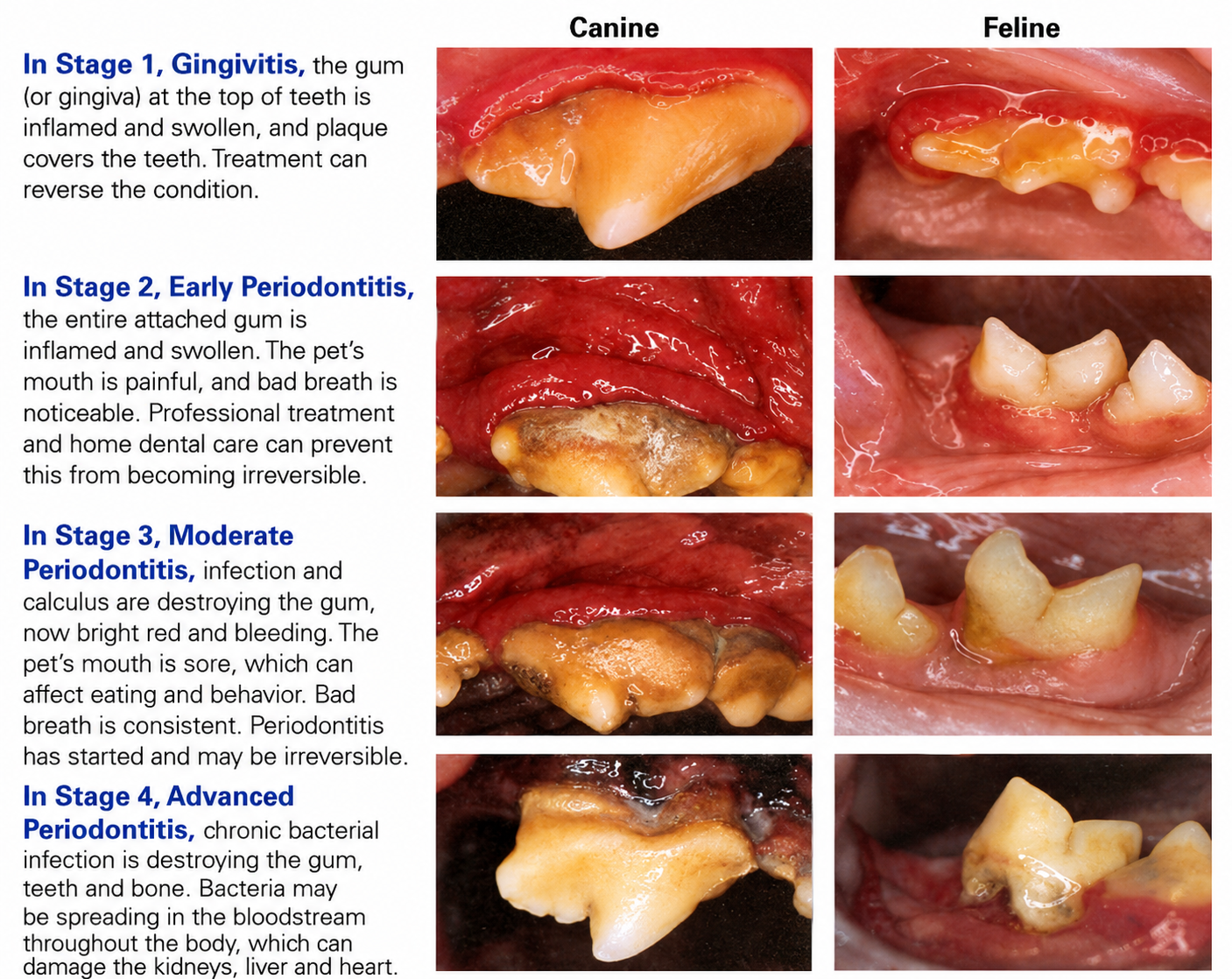
⚠️ SIGNS OF DENTAL DISEASE
Contact your veterinarian if you notice:
- Bad breath
- Excessive drooling
- Difficulty eating or chewing
- Red, swollen, or bleeding gums
- Loose, broken, or missing teeth
- Pawing at the mouth or face
- Dropping food while eating
- Chewing on one side of the mouth
- Decreased appetite
- Weight loss
❤️ IMPORTANT: A pet eating normally does not mean their mouth is healthy.
Pets can have significant dental disease and continue to eat normally.
🪥 DAILY DENTAL CARE
Daily dental care is for prevention—it helps slow the buildup of new plaque and tartar, but it cannot treat or reverse dental disease that is already present.
Ideally, dental care should begin before dental disease develops and should be continued consistently, especially after a professional dental cleaning, to help maintain those results.
Brushing Is the Best Prevention
Daily tooth brushing with a pet-safe toothbrush and toothpaste, such as Virbac C.E.T. Enzymatic Toothpaste & Toothbrush, is the #1 way to prevent plaque and tartar buildup.
Starting when your pet is young makes this much easier, but older pets can learn too!
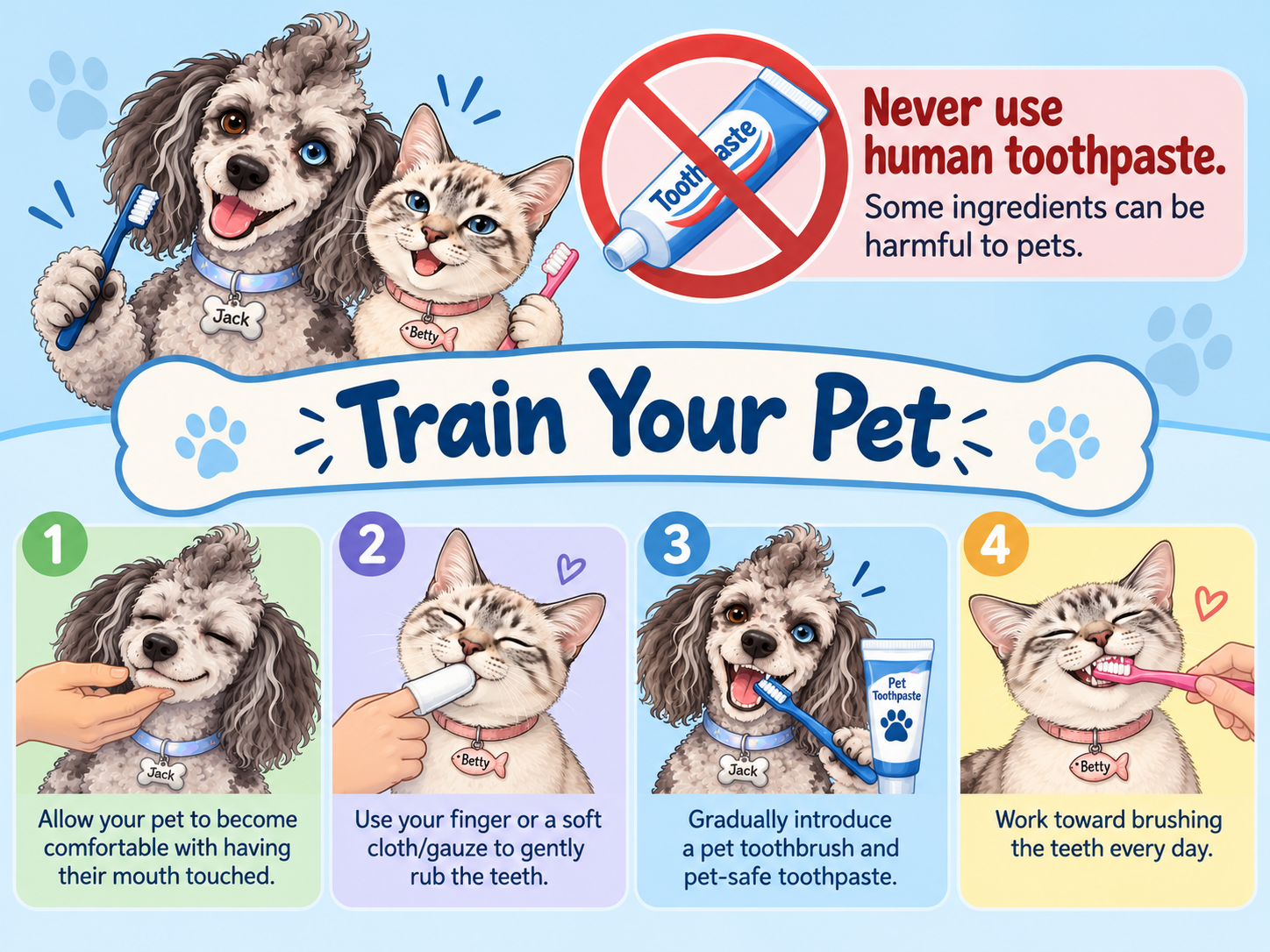
Never use human toothpaste. Some ingredients can be harmful to pets.
🛒 Looking for dental care products for your pet? We’ve selected some of our recommended options below.
🦷 VOHC-APPROVED PRODUCTS
Can't brush your pet's teeth every day? I get it—it is hard!
The goal is to do something rather than nothing.
Think of these products as an addition to brushing—not a replacement for it.
They are generally not as effective as brushing, but the right products can help reduce plaque and tartar when brushing isn't possible every day.
If your pet has a sensitive stomach, consider introducing new dental treats or products gradually and monitor for 24–48 hours for vomiting or diarrhea before continuing to use them regularly.
Look for the Veterinary Oral Health Council (VOHC) seal—but not all VOHC-approved products provide the same benefits.
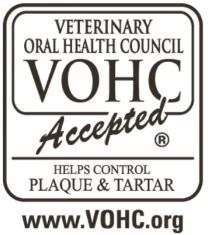
Some products are approved to help control plaque, while others are approved to help control tartar.
⭐ When possible, choose a product that helps control BOTH plaque AND tartar.
For a current list of approved dental products for dogs and cats, visit the Veterinary Oral Health Council (VOHC) website:
🌐 VOHC-Approved Products
🪥 Think About It This Way:
Brushing is best because it physically removes plaque from the teeth.
Mechanical action from chewing can also be helpful. Dental chews are designed to provide this mechanical action and can be especially useful on days when you cannot brush your pet's teeth.
Examples of dental products that may help include:
- Virbac C.E.T. Enzymatic Chews
- Virbac Aquadent Dental Solution
- Important: If you use a water additive, make sure your pet continues to drink normally. Some pets may dislike the taste and drink less, which can increase the risk of dehydration.
- And other veterinary-recommended dental products
Safe chew toys can provide mechanical benefits, but they are not a replacement for brushing or proven dental products.
🛒 Looking for dental care products for your pet? We’ve selected some of our recommended options below.
⚠️ Avoid Extremely Hard Chews
Avoid extremely hard objects such as:
- Bones
- Antlers
- Rocks
- Very hard nylon toys
🦷 A simple rule: If you cannot bend or slightly dent an object with your fingernail, it may be hard enough to damage or fracture a tooth.
🍽️ DENTAL DIETS
Certain veterinary dental diets are specifically designed to help reduce plaque and tartar.
Hill's Prescription Diet t/d
This diet uses a specially designed kibble structure to help mechanically reduce plaque and tartar as your pet chews.
A dental diet can be a helpful part of your pet's dental routine, but it does not replace tooth brushing or professional dental care.
🩺 PROFESSIONAL DENTAL CLEANING
Even with excellent home dental care, many pets will eventually need a professional dental cleaning.
A proper veterinary dental procedure should be performed under general anesthesia, allowing the veterinary team to:
- Examine every tooth individually
- Clean above and below the gumline
- Measure periodontal pockets
- Perform dental X-rays
- Identify painful or diseased teeth
- Remove teeth that cannot be saved
🦷 Choose a Veterinary Team That Can Do More Than Just Clean Teeth
When choosing where to have your pet's dental procedure performed, ask whether the veterinary team performs dental X-rays and dental extractions when needed.
Not every clinic that offers dental cleanings is equipped or comfortable performing extractions.
If a painful, infected, fractured, or otherwise diseased tooth is identified on dental X-rays, removing it during the same anesthetic procedure means your pet can receive the treatment they need without having to undergo anesthesia a second time.
🩻 WHY ARE DENTAL X-RAYS IMPORTANT?
More than half of each tooth is below the gumline.
That means a large portion of the tooth cannot be evaluated simply by looking inside your pet's mouth.
Dental X-rays allow us to see what is happening below the gumline and can reveal:
- Tooth root disease
- Bone loss
- Abscesses
- Fractured teeth
- Resorptive lesions, especially in cats
- Other disease hidden below the gumline
Without dental X-rays, important dental disease can be missed.
Dental X-rays help determine which teeth need to be extracted and allow the veterinary team to properly evaluate the areas that cannot be seen during a visual examination.
⚠️ WHAT ABOUT "ANESTHESIA-FREE" DENTAL CLEANINGS?
Anesthesia-free dental cleanings may sound appealing because they avoid anesthesia.
The problem is that they primarily remove visible tartar from the surface of the teeth.
They cannot adequately:
- Evaluate disease below the gumline
- Treat disease below the gumline
- Perform a complete dental examination
- Perform dental X-rays properly
- Identify many painful or diseased teeth
This means significant periodontal disease can be missed.
Anesthesia-free dental cleaning is not a substitute for a comprehensive veterinary dental procedure.
❤️ WHAT ABOUT MY PET'S AGE?
One of the most common concerns I hear from pet owners is:
“I'm afraid to put my pet under anesthesia because they are too old. What if they don't wake up?”
This is an understandable concern—but age alone is not a disease.
Pets are living longer lives, and that means they are also living long enough to develop dental disease that needs to be treated.
Pets 10 years of age and older can still benefit greatly from professional dental care.
I routinely perform dental procedures on senior pets.
The decision to proceed with anesthesia should not be based on age alone.
Instead, we look at your pet's overall health and individual anesthetic risk.
Before a dental procedure, we make sure your pet has:
- A thorough physical examination
- Appropriate pre-anesthetic blood work
- Existing health conditions evaluated and addressed
- Any additional testing or preparation that may be appropriate before anesthesia
🩺 During the procedure:
Your pet is carefully monitored by the veterinary team throughout anesthesia.
If your pet is not doing well or we feel that continuing the procedure is not in your pet's best interest, the procedure can be stopped.
❤️ The goal is always the same: Treat dental disease while keeping your pet as safe and comfortable as possible.
🦷 HOW OFTEN DOES MY PET NEED A DENTAL?
There is no single schedule that works for every pet.
Your veterinarian will recommend a dental cleaning schedule based on your pet's:
- Age
- Breed
- Oral health
- Home dental care
- Previous dental disease
- Dental X-ray findings
Some pets may need professional cleanings every 6 months, while others may go 1–2 years between procedures.
Your pet's dental health should be evaluated regularly so that problems can be identified before they become painful or more difficult to treat.
⭐ PREVENTION IS THE BEST DENTAL CARE
The best dental care is a combination of:
- 🪥 Daily brushing
- 🦷 VOHC-approved dental products
- 🩺 Regular veterinary dental examinations
- 🦷 Professional cleanings when needed
❤️ Remember:
Have your pet's teeth and mouth evaluated by your veterinarian at least once a year, even if they are eating normally and you don't notice any problems.
Good dental health is not a luxury.
It is an important part of keeping your pet comfortable, healthy, and happy.
🛒 RECOMMENDED DENTAL CARE PRODUCTS
There are many dental care products available for dogs and cats, but not all products provide the same benefits.
We’ve selected dental care products that we believe can be helpful additions to your pet’s at-home dental care routine.
🌐 View Our Recommended Dental Care Products
Remember: At-home dental care is important, but it does not replace regular veterinary dental examinations and professional dental cleanings when recommended.
❓HAVE MORE QUESTIONS?
We’re here to help you keep your furbaby happy, healthy, and thriving! ❤️
For additional pet health information, visit Veterinary Partner by VIN—a trusted resource with veterinarian-written articles.
🔎 Tip: Search “VIN + your question” on Google for easier results, as the website’s search feature can be a little tricky.
📞 And remember, calling us is always free!
If you have questions or concerns about your pet, please don’t hesitate to reach out. We’re happy to help. 🐾